Understand Section 16 of the MSME Act, statutory interest at 3 times RBI bank rate, monthly compounding, 45-day payment rule and recovery remedies.
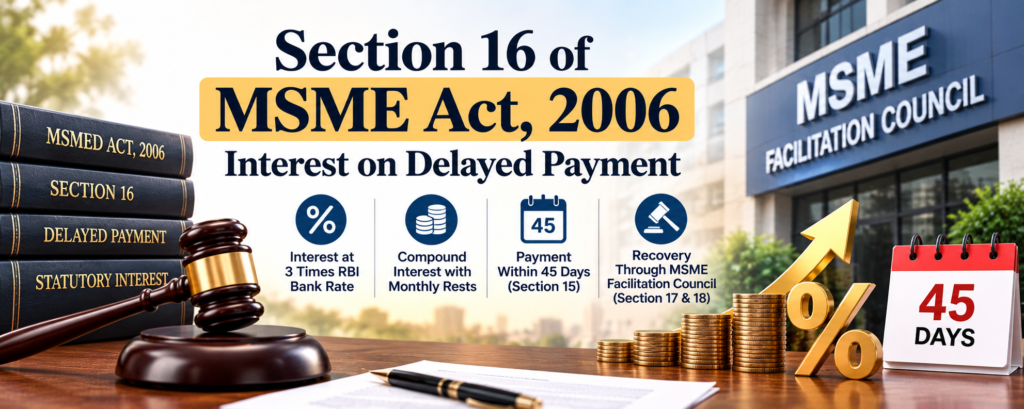
Section 16 of MSME Act, 2006: Interest on Delayed Payments, Three Times RBI Bank Rate and Monthly Compounding
Section 16 of the Micro, Small and Medium Enterprises Development Act, 2006 (MSMED Act) is one of the most important provisions protecting micro and small enterprises against delayed payments. It imposes a statutory obligation on buyers to pay interest when they fail to make payments within the period prescribed under Section 15 of the Act.
Under Section 16 of the MSME Act, a buyer who delays payment must pay compound interest with monthly rests at three times the bank rate notified by the Reserve Bank of India (RBI). This interest liability applies notwithstanding anything contained in an agreement between the buyer and supplier or any other law in force.
The provision gives MSME suppliers a significant legal remedy against buyers who withhold payments beyond the prescribed period. It also prevents buyers from avoiding statutory interest merely by relying on contractual provisions that prescribe a lower rate of interest.
For businesses dealing with MSME suppliers, understanding Section 16 is essential because delayed payments can result in substantial interest liability in addition to the original invoice amount.
This article explains Section 16 of the MSMED Act, its legal interpretation, the applicable interest rate, monthly compounding, the relationship with Section 15, and the remedies available to MSMEs for recovering outstanding payments.
Section 16 of the MSMED Act, 2006 deals with the date from which and the rate at which interest becomes payable when a buyer delays payment to a micro or small enterprise.
The provision creates a mandatory statutory interest obligation.
In substance, Section 16 provides that where a buyer fails to make payment as required under Section 15, the buyer becomes liable to pay compound interest with monthly rests to the supplier.
The interest must be calculated at three times the bank rate notified by the Reserve Bank of India.
The provision contains an overriding clause. Consequently, the buyer cannot ordinarily avoid statutory interest by relying on a contractual agreement prescribing a lower interest rate.
| Particulars | Legal position |
|---|---|
| Governing legislation | MSMED Act, 2006 |
| Relevant provision | Section 16 |
| Beneficiary | Eligible micro and small enterprise supplier |
| Person liable | Buyer |
| Interest rate | Three times RBI-notified bank rate |
| Nature of interest | Compound interest |
| Compounding frequency | Monthly rests |
| Commencement | Appointed day or day immediately following the agreed payment date, as applicable |
| Overriding effect | Overrides inconsistent contractual provisions and other laws |
Official statutory text: Section 16 of the MSMED Act – Income Tax Department.
Section 16 prescribes interest at three times the bank rate notified by the Reserve Bank of India.
The applicable formula is:
MSME Statutory Interest Rate = 3 × RBI Bank Rate
For example, if the RBI bank rate is 5.50%, the statutory interest rate under Section 16 will be:
5.50% × 3 = 16.50% per annum.
However, the actual rate depends on the RBI bank rate applicable during the relevant period. Therefore, suppliers should verify the RBI notifications before preparing an interest calculation.
The RBI announces different monetary policy rates. These include the repo rate, bank rate, standing deposit facility rate and marginal standing facility rate.
For calculating interest under Section 16, the relevant benchmark is the bank rate notified by the RBI, not the repo rate.
Using the repo rate instead of the bank rate may result in an incorrect statutory interest calculation.
One of the most significant features of Section 16 is its requirement of compound interest with monthly rests.
This means that interest is calculated at monthly intervals and added to the outstanding amount for subsequent interest calculations.
The statutory provision does not prescribe simple interest. It specifically requires compound interest with monthly rests.
| Particulars | Simple interest | Compound interest |
|---|---|---|
| Calculation basis | Original principal | Principal plus accumulated interest |
| Interest accumulation | Does not compound | Compounds periodically |
| Monthly rests | Not applicable | Applicable under Section 16 |
| MSME statutory requirement | No | Yes |
The difference becomes substantial when payment remains outstanding for several years.
For example, if a buyer delays payment of ₹10 lakh, the interest liability under Section 16 can increase considerably because interest accumulates through monthly compounding.
Therefore, an MSME supplier should prepare its claim using the statutory method rather than applying a simple annual interest formula.
The commencement date of statutory interest depends on Section 15 of the MSMED Act and the payment agreement between the parties.
Section 15 provides that a buyer must make payment on or before the date agreed upon in writing. If there is no written agreement, the buyer must make payment before the appointed day.
The agreed payment period cannot exceed 45 days from the date of acceptance or deemed acceptance of goods or services.
Section 16 determines the date from which interest becomes payable.
Where the parties have not agreed upon a payment date in writing, interest becomes payable from the appointed day.
The appointed day generally means the day immediately following the expiry of 15 days from acceptance or deemed acceptance of goods or services.
Where the parties have agreed in writing to a payment period within the statutory maximum, interest becomes payable from the date immediately following the agreed payment date.
For example:
Section 15 does not permit the parties to agree upon a payment period exceeding 45 days from acceptance or deemed acceptance.
A contractual payment period exceeding 45 days cannot ordinarily postpone the statutory payment obligation.
Accordingly, the statutory payment deadline must be determined by applying the 45-day maximum, and interest may become payable from the day immediately following that deadline.
Sections 15 and 16 must be read together.
Section 15 establishes the buyer’s obligation to make payment within the prescribed period. Section 16 creates the statutory interest liability when the buyer fails to comply with that obligation.
The provisions operate together as follows:
| Provision | Subject | Legal effect |
|---|---|---|
| Section 15 | Liability of buyer to make payment | Prescribes the payment deadline, subject to the 45-day maximum |
| Section 16 | Date and rate of interest | Imposes compound interest at three times RBI bank rate |
| Section 17 | Recovery of amount due | Makes the buyer liable to pay principal and statutory interest |
| Section 18 | Reference to MSEFC | Provides the statutory dispute resolution mechanism |
| Section 19 | Application for setting aside award | Requires a 75% deposit by a non-supplier appellant, subject to the statutory provision |
A supplier seeking recovery should establish the payment default under Section 15 before claiming interest under Section 16.
No, not ordinarily.
Section 16 begins with a non obstante clause. It expressly provides that the statutory interest obligation applies notwithstanding anything contained in an agreement between the buyer and supplier or any law in force.
Therefore, a contractual clause prescribing interest at 9%, 12% or 15% per annum cannot ordinarily replace the statutory rate where Section 16 applies.
Similarly, the absence of an interest clause in the purchase order or commercial agreement does not, by itself, remove the statutory liability.
Assume that a purchase order contains the following condition:
“Interest on delayed payment shall be payable at 9% per annum.”
If the supplier is eligible for protection under the MSMED Act and the buyer defaults under Section 15, the statutory rate under Section 16 will ordinarily prevail over the contractual rate.
The buyer cannot simply rely on the contractual provision to avoid the higher statutory interest.
This principle makes Section 16 an important protective provision for eligible MSME suppliers.
Courts have repeatedly recognised the special nature of statutory interest under Section 16.
Court: Delhi High Court
Date: 6 July 2023
Case: W.P.(C) 13754/2019 and connected matter.
The Delhi High Court examined the statutory provisions governing delayed payments under Sections 15, 16 and 17 of the MSMED Act.
The Court explained that Section 16 contemplates three essential features:
The judgment reinforces that the interest calculation must follow the statutory formula and not an ordinary contractual interest calculation.
This decision is particularly relevant when preparing MSME interest claims and challenging incorrect interest calculations.
Read the Delhi High Court judgment.
Court: Delhi High Court
Case: W.P.(C) 11233/2021.
The Delhi High Court considered the statutory payment obligations and the protection available to micro and small enterprises under Sections 15 to 18 of the MSMED Act.
The Court recognised that the statutory framework provides for payment within a maximum period of 45 days and imposes a higher rate of interest in case of default.
The decision is relevant for understanding the relationship between the contractual payment terms and the statutory obligations under the MSMED Act.
The Supreme Court, in its judgment dated 17 July 2025, examined the statutory recovery framework under Sections 16, 17 and 18 of the MSMED Act.
The judgment discusses how the statutory interest under Section 16 forms part of the amount recoverable under Section 17 and the remedies available under Section 18.
It is relevant to understanding the relationship between statutory interest and the MSME dispute resolution mechanism.
Read the Supreme Court judgment.
Yes.
Section 16 creates a statutory obligation independent of an express contractual interest clause.
The supplier does not necessarily need to establish that the buyer agreed to pay interest in the purchase order or commercial agreement.
The supplier must, however, establish that:
Once the statutory conditions are satisfied, interest becomes payable in accordance with Section 16.
The calculation of interest under Section 16 requires consideration of the principal amount, the date of default, the applicable RBI bank rate and monthly compounding.
Assume the following:
| Particulars | Details |
|---|---|
| Outstanding invoice | ₹10,00,000 |
| RBI bank rate (illustrative) | 5.50% |
| Statutory interest rate | 16.50% |
| Interest period | 12 months |
| Compounding | Monthly |
The monthly rate is:
16.50% ÷ 12 = 1.375%.
The illustrative formula is:
[
A=P\left(1+\frac{r}{12}\right)^{12}
]
Where:
For ₹10 lakh at a constant illustrative rate of 16.50%:
| Particulars | Amount |
|---|---|
| Principal | ₹10,00,000 |
| Interest after 12 monthly periods | Approximately ₹1,77,900 |
| Total amount | Approximately ₹11,77,900 |
This is only an illustration. Actual calculations must account for the RBI bank rate applicable during each relevant period, exact monthly rests, the statutory commencement date and any part-payments.
Where the RBI bank rate changes, the calculation should reflect the applicable rate at the relevant monthly rests rather than automatically using one fixed rate for the entire claim.
Sections 15 to 18 of the MSMED Act specifically protect micro and small enterprise suppliers in the delayed-payment framework.
The statutory definition of supplier and the registration requirements must be examined before claiming the benefit of Section 16.
A medium enterprise should not assume that it can claim statutory delayed-payment interest under Section 16 merely because it holds an Udyam registration.
The classification of the enterprise and the nature and timing of the relevant registration are important considerations.
The eligibility of traders requires separate consideration.
The Government has issued directions permitting Udyam registration for certain wholesale and retail traders, but their benefits under the MSMED Act have been restricted in relevant government directions.
A trader should not assume that registration alone automatically creates an entitlement to statutory delayed-payment interest under Section 16.
The nature of the business, applicable government directions and judicial precedents should be examined before initiating an MSME recovery claim.
An eligible supplier can pursue recovery through the statutory mechanism under the MSMED Act.
The supplier may issue a demand notice identifying:
The supplier should collect its Udyam registration, purchase orders, invoices, delivery records, acceptance documents, ledger statements and payment correspondence.
The supplier may initiate proceedings before the competent Micro and Small Enterprises Facilitation Council under Section 18.
The MSME Samadhaan portal provides an online facility for submitting delayed-payment references.
Official portal: https://samadhaan.msme.gov.in/
The Council initially undertakes conciliation or refers the dispute to an appropriate institution or centre.
If conciliation fails, the Council may take up the arbitration itself or refer the dispute to an institution or centre for arbitration under the statutory framework.
After obtaining an enforceable award, the supplier may initiate appropriate execution proceedings for recovery of the principal amount and statutory interest.
A buyer who defaults on payment to an eligible MSME supplier may face several legal and financial consequences.
Statutory interest liability: The buyer becomes liable to pay compound interest at three times the RBI bank rate with monthly rests.
MSME Facilitation Council proceedings: The supplier may initiate statutory proceedings for recovery of the outstanding amount and interest.
Arbitral award: The dispute may result in an arbitral award directing the buyer to pay the principal and statutory interest.
75% pre-deposit requirement: Under Section 19, a buyer or other appellant who is not the supplier must deposit 75% of the amount in terms of the award or order before a court entertains an application to set it aside, subject to the statutory requirements.
Financial and litigation costs: The buyer may also incur legal expenses and other costs associated with defending and complying with the proceedings.
An MSME supplier should maintain proper documentary evidence before initiating recovery proceedings.
The following documents are generally relevant:
A proper invoice-wise interest statement is particularly important because the amount and commencement date may differ for individual invoices.
Section 16 of the MSMED Act, 2006 prescribes statutory interest payable by a buyer who fails to make payment to an eligible micro or small enterprise within the period prescribed under Section 15.
The interest rate is three times the bank rate notified by the RBI. The rate changes when the applicable RBI bank rate changes.
Section 16 expressly provides for compound interest with monthly rests.
Where the MSMED Act applies, the statutory rate under Section 16 generally prevails over an inconsistent contractual interest rate.
Interest becomes payable from the appointed day or the date immediately following the agreed payment date, as applicable under Sections 15 and 16.
Yes. Section 15 does not permit the written payment period to exceed 45 days from acceptance or deemed acceptance of goods or services.
The buyer may raise genuine disputes concerning the supply, quality, quantity or amount payable. The Council or arbitral tribunal will examine the merits. A supplier must establish its entitlement to the principal amount before claiming the associated statutory interest.
Section 16 overrides inconsistent contractual provisions concerning statutory interest. The separate statutory dispute resolution framework under Section 18 must also be considered. An ordinary arbitration clause does not automatically prevent an eligible supplier from invoking the MSMED Act.
Yes, subject to the applicable limitation requirements and the merits of the underlying claim. The supplier must calculate the interest for the relevant period using the applicable RBI bank rates and monthly compounding.
Yes. A buyer may challenge an award in accordance with the Arbitration and Conciliation Act, 1996 and applicable law. Section 19 of the MSMED Act requires a non-supplier appellant to deposit 75% of the award amount as a condition for entertaining an application to set aside the award.
Section 16 of the MSMED Act, 2006 provides a powerful statutory remedy to micro and small enterprises facing delayed payments. It requires buyers to pay compound interest with monthly rests at three times the bank rate notified by the Reserve Bank of India.
The provision operates alongside Sections 15, 17 and 18. Together, these sections establish payment deadlines, statutory interest liability and a mechanism for recovery through the Micro and Small Enterprises Facilitation Council.
For suppliers, a proper understanding of Section 16 can significantly strengthen an MSME payment recovery claim. For buyers, timely payment and careful compliance with the MSMED Act can help prevent substantial statutory interest liability and prolonged litigation.
Businesses should therefore review their MSME transactions, contractual payment terms and outstanding invoices to ensure compliance with the statutory payment framework.
NB Associates – Advocates & Legal Consultants
NB Associates provides legal assistance in MSME delayed-payment disputes, Section 16 interest claims, MSME Samadhaan proceedings, MSME Facilitation Council matters, commercial arbitration and recovery of outstanding payments.
Our legal team assists suppliers and buyers with:
Phone: 9811899279
Email: mail@nbassociates.net
Client may contact NB Associates for legal assistance concerning Section 16 of the MSME Act and recovery of delayed payments.
This page is intended for informative purposes only and does not constitute solicitation of client or legal advice.
For advice specific to your situation existing clients may please consult our team.
