RBI Interest Rate for MSME Delayed Payment: Interest Rate, Calculation and Legal Remedies
Introduction
The RBI interest rate for MSME delayed payment is an important consideration for micro and small enterprises seeking to recover outstanding invoices from buyers. Delayed payments can affect working capital, business operations and the ability of an enterprise to meet its financial obligations. To address this problem, the Micro, Small and Medium Enterprises Development Act, 2006 (MSMED Act) provides a special statutory mechanism for recovering outstanding payments along with interest.
Under Section 16 of the MSMED Act, a buyer who fails to make payment within the prescribed period must pay compound interest with monthly rests at three times the bank rate notified by the Reserve Bank of India (RBI). This statutory interest applies notwithstanding anything contained in an agreement between the buyer and the supplier or any other law in force.
The RBI bank rate is therefore central to calculating MSME delayed payment interest. However, businesses must distinguish the RBI bank rate from the repo rate and other monetary policy rates.
Suppliers should also understand Sections 15, 16, 17 and 18 of the MSMED Act because these provisions govern payment deadlines, statutory interest, recovery of dues and dispute resolution through the Micro and Small Enterprises Facilitation Council (MSEFC).
Section 16 of the MSMED Act prescribes the interest rate applicable to delayed payments to eligible micro and small enterprises.
The statutory formula is:
MSME delayed payment interest rate = 3 × RBI bank rate
The interest carries monthly rests, which means the law requires compounding at monthly intervals.
For example, if the applicable RBI bank rate is 5.50% per annum, the statutory annual interest rate is:
5.50% × 3 = 16.50% per annum
This is the nominal annual statutory rate before accounting for monthly compounding.
The RBI bank rate may change over time. Therefore, a supplier claiming interest for several months or years should verify the applicable bank rate for the relevant period.
The statutory interest rate differs from the ordinary interest rate mentioned in a commercial contract. Where Section 16 applies, a contractual provision specifying a lower interest rate does not ordinarily displace the statutory rate.
Official reference: Section 16 of the MSMED Act, 2006.
The Reserve Bank of India publishes several monetary policy rates, including the repo rate, standing deposit facility rate, marginal standing facility rate and bank rate.
For MSME delayed payment claims, the relevant benchmark under Section 16 is the bank rate notified by the RBI, not the repo rate merely because it receives greater public attention.
At the time of preparing this article, the RBI’s published rates list the bank rate at 5.50%. Three times this rate produces a statutory annual rate of 16.50%.
Businesses should verify the latest rate on the official RBI website before calculating or filing a claim.
The following table illustrates the calculation at different hypothetical bank rates.
| RBI bank rate | Statutory rate under Section 16 |
|---|---|
| 5.00% | 15.00% per annum |
| 5.25% | 15.75% per annum |
| 5.50% | 16.50% per annum |
| 5.75% | 17.25% per annum |
| 6.00% | 18.00% per annum |
| 6.50% | 19.50% per annum |
These examples illustrate the statutory formula. They do not represent a historical record of RBI rate changes.
If the RBI changes the bank rate during the period of default, the supplier should examine the relevant notifications and applicable calculation method before finalising the interest claim.
Section 16 establishes the statutory liability of a buyer who fails to pay an eligible micro or small enterprise within the period prescribed under Section 15.
The provision contains three important elements.
The buyer must pay interest at three times the bank rate notified by the RBI. The parties cannot ordinarily contract out of this statutory liability where the Act applies.
Section 16 expressly provides for compound interest with monthly rests. Consequently, the interest calculation differs from simple interest calculated only on the original principal.
Interest becomes payable from the appointed day or, where applicable, the day immediately following the agreed payment date, subject to Section 15 and the applicable statutory rules.
The correct starting date depends on the contract, the acceptance or deemed acceptance of the goods or services, and the statutory payment period.
Section 15 of the MSMED Act regulates the period within which a buyer must pay a micro or small enterprise.
The payment deadline depends on whether the parties have agreed on a written payment date.
Where the parties have a written agreement: The buyer must pay by the agreed date, but the agreed payment period cannot exceed 45 days from the date of acceptance or deemed acceptance of the goods or services.
Where there is no written agreement: The buyer must pay before the appointed day, as defined under the Act.
The appointed day generally falls immediately after the expiry of 15 days from acceptance or deemed acceptance.
For example, assume a buyer accepts goods on 1 April and the parties have agreed in writing to a 30-day payment period. The agreed payment period runs from the relevant acceptance date. If the buyer does not pay by the contractual deadline, statutory interest may become payable from the date prescribed under Sections 15 and 16.
The exact interest commencement date must be calculated from the relevant contractual and statutory dates rather than assumed solely from the invoice date.
An MSME supplier should calculate interest on the outstanding amount using the statutory rate and monthly compounding method.
The calculation generally requires the following information:
Assume the following facts:
| Particulars | Amount or date |
|---|---|
| Outstanding principal | ₹10,00,000 |
| Illustrative RBI bank rate | 5.50% per annum |
| Statutory annual interest rate | 16.50% |
| Illustrative delay | 12 months |
| Compounding frequency | Monthly |
For illustration, assume a constant nominal annual rate of 16.50%, with monthly compounding throughout the 12-month period.
The monthly rate is:
16.50% ÷ 12 = 1.375%
The compound interest formula is:
[
A=P\left(1+\frac{r}{12}\right)^{12}
]
Where:
Applying the formula:
[
A=₹10,00,000(1+0.165/12)^{12}
]
The illustrative result is approximately:
| Particulars | Amount |
|---|---|
| Principal | ₹10,00,000 |
| Amount after 12 monthly compounding periods | ₹11,77,900 |
| Illustrative interest | ₹1,77,900 |
This example is an approximation, not a final legal interest calculation. Actual claims must account for the statutory commencement date, the applicable RBI bank rate over the relevant period, the precise compounding method and any part-payments.
The MSMED Act expressly provides for compound interest with monthly rests.
This is an important distinction because simple interest does not account for monthly compounding.
Under simple interest, interest is calculated only on the original principal. Under monthly compounding, interest is periodically added to the outstanding balance for subsequent calculations, in accordance with the applicable method.
For example, a supplier claiming ₹10 lakh with a nominal annual rate of 16.50% cannot automatically calculate the entire claim as simple interest at 16.50% for each year. The statutory requirement for monthly rests must be considered.
A proper calculation should also avoid applying an incorrect rate to a period when the RBI bank rate differed.
Section 16 begins with a non obstante clause. It imposes statutory interest notwithstanding anything contained in an agreement between the buyer and supplier or any other law in force.
Accordingly, where the MSMED Act applies, a buyer generally cannot avoid the statutory interest obligation merely by relying on a contractual clause prescribing a lower rate.
Similarly, a contractual term allowing payment after more than 45 days cannot ordinarily override the maximum payment period under Section 15.
However, the supplier must still establish that the claim qualifies for protection under the Act and that the statutory requirements have been satisfied.
Sections 17 and 18 of the MSMED Act provide the statutory framework for recovering outstanding amounts and resolving disputes.
The supplier may issue a written demand identifying the invoices, principal outstanding, applicable interest and payment deadline.
The supplier should organise:
An eligible supplier may approach the appropriate Micro and Small Enterprises Facilitation Council under Section 18.
The MSME Samadhaan portal provides an online mechanism for submitting delayed-payment references. The supplier should verify the current filing procedure and any additional requirements of the relevant Council.
Official portal: MSME Samadhaan.
The Council first undertakes conciliation in accordance with the statutory framework. If conciliation fails, the dispute may proceed to arbitration as provided under Section 18.
Under Section 17, the buyer is liable to pay the amount due along with interest calculated under Section 16.
The supplier should therefore present a clear calculation of principal, interest and payments already received.
The statutory delayed-payment mechanism under Sections 15 to 18 applies to eligible micro and small enterprise suppliers, subject to the Act and relevant judicial decisions.
An enterprise should verify its registration status, the applicable registration requirements and the nature of its business activity before initiating proceedings.
In particular, enterprises engaged solely in trading should not assume that they qualify for every remedy under the MSMED Act. The eligibility of traders requires separate examination under the applicable government directions and judicial precedents.
The supplier should also check whether the registration and other statutory requirements were satisfied at the legally relevant time for the transaction.
A well-documented claim helps establish the principal amount, the date of default and the applicable statutory interest.
The supplier should maintain the following records:
The supplier should reconcile its books with the buyer’s account and account for any credit notes, disputed invoices or partial payments before filing the claim.
Businesses frequently make errors when calculating delayed-payment interest. The most common mistakes include:
Using the repo rate instead of the bank rate: Section 16 refers specifically to the bank rate notified by the RBI.
Applying simple interest: The statute prescribes compound interest with monthly rests.
Using the invoice date automatically: The statutory commencement date depends on Section 15, the acceptance date and the applicable payment agreement.
Ignoring changes in the bank rate: A claim spanning different rate periods requires careful examination of the applicable rates.
Overlooking part-payments: Payments received during the claim period can affect the outstanding principal and subsequent interest calculation.
Assuming every business qualifies: Registration status, business activity and statutory eligibility require verification.
Claiming interest without supporting records: An invoice-wise statement and a transparent calculation make the claim easier to verify.
Section 16 of the MSMED Act prescribes interest at three times the bank rate notified by the RBI. If the applicable bank rate is 5.50%, the statutory annual rate is 16.50%.
It is 16.50% per annum when the applicable RBI bank rate is 5.50%. The statutory rate changes with the applicable bank rate.
Yes. Section 16 expressly provides for compound interest with monthly rests.
Where the applicable payment period expires without payment, the supplier may claim statutory interest from the date determined under Sections 15 and 16. The 45-day limit is the maximum agreed payment period, not a universal rule that interest always begins on the 46th day.
Yes. Where the statutory requirements are satisfied, Section 16 provides the interest obligation independently of a contractual interest clause.
A buyer cannot ordinarily avoid the statutory obligation merely because the contract specifies a lower rate or does not mention interest. However, the buyer may raise legally sustainable objections concerning the applicability of the Act, the amount due, the calculation or the commencement date.
An eligible micro or small enterprise may submit a reference through the MSME Samadhaan mechanism and pursue the matter before the competent Micro and Small Enterprises Facilitation Council, following the applicable procedure.
The liability to interest may continue while the amount remains unpaid, subject to the governing statutory provisions, the terms of the award or decision and applicable law. The calculation should reflect payments and the relevant period.
The RBI interest rate for MSME delayed payment is governed by Section 16 of the MSMED Act, 2006. The provision requires buyers to pay compound interest with monthly rests at three times the bank rate notified by the Reserve Bank of India.
Where the applicable bank rate is 5.50%, the statutory annual rate is 16.50%. However, suppliers should verify the applicable RBI rates and calculate interest from the correct statutory date.
MSMEs should maintain complete transaction records, verify their eligibility and prepare an accurate interest statement before initiating recovery proceedings. Where the buyer refuses to pay, the supplier may consider the remedies available under Sections 17 and 18 of the MSMED Act.
NB Associates – Advocates & Legal Consultants
NB Associates assists businesses with MSME payment recovery, delayed-payment interest claims, MSME Samadhaan proceedings, Facilitation Council disputes, commercial arbitration and enforcement of arbitral awards.
Our team can assist with legal notices, invoice-wise interest calculations, preparation of MSME references, jurisdictional objections and recovery proceedings.
Office: New Delhi and Ghaziabad, Delhi NCR
Phone: 9811899279
Email: mail@nbassociates.net
Contact NB Associates for legal assistance concerning MSME delayed payment interest and recovery of outstanding commercial dues.
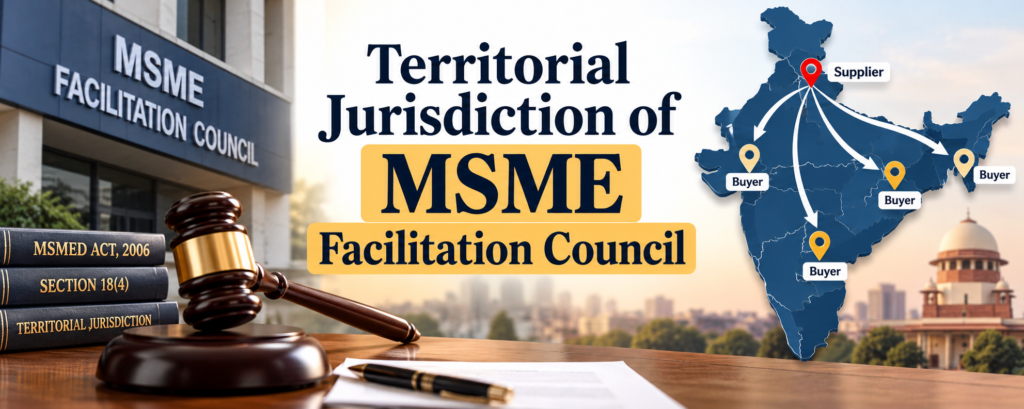
Territorial Jurisdiction of MSME Facilitation Council: A Complete Legal Guide
This Article is about territorial jurisdiction of the MSME Facilitation Council or MSME Facilitation Council Jurisdiction, Section 18(4) MSMED Act, Section 18(5) MSMED Act,
The territorial jurisdiction of the MSME Facilitation Council is an important legal issue in disputes involving delayed payments to micro and small enterprises. Buyers and suppliers often operate in different states, execute contracts in one location, and deliver goods or services in another. These circumstances can create confusion about which Micro and Small Enterprises Facilitation Council (MSEFC) has the authority to entertain a payment recovery claim.
Section 18(4) of the Micro, Small and Medium Enterprises Development Act, 2006 (MSMED Act) provides the principal rule for determining jurisdiction. It empowers the MSME Facilitation Council, or an alternative dispute resolution center acting under the statutory framework, to conduct proceedings between a supplier located within its jurisdiction and a buyer located anywhere in India. The provision operates notwithstanding anything contained in any other law for the time being in force.
Read the Supreme Court judgment in M/s Harcharan Dass Gupta v. Union of India
Understanding this provision helps businesses determine the appropriate forum, assess jurisdictional objections, and avoid unnecessary litigation. It also helps buyers evaluate whether they can challenge proceedings initiated by an MSME supplier before a Council located in another state.
The MSME Facilitation Council is a statutory dispute resolution forum established under Section 20 of the MSMED Act. It addresses disputes concerning amounts due to micro and small enterprise suppliers and facilitates the recovery of outstanding payments under the Act.
A supplier that satisfies the applicable statutory requirements can approach the appropriate Council for recovery of eligible dues from a buyer. The Council follows the dispute resolution procedure prescribed under Section 18.
The process generally involves:
The territorial jurisdiction of the Council determines where the statutory proceedings may be initiated. However, territorial jurisdiction alone does not establish that every supplier qualifies for relief under the MSMED Act. The supplier must also satisfy the applicable registration and claim-related requirements.
About NB Associates – Advocates & Legal Consultants
NB Associates advises businesses on MSME disputes, MSME Facilitation Council proceedings, commercial arbitration, delayed payment claims, debt recovery and enforcement of arbitral awards.
Our legal team assists suppliers and buyers with jurisdictional objections, preparation of claims and defences, MSME Samadhaan proceedings, arbitration strategy and related commercial litigation.
Phone: 9811899279
Email: mail@nbassociates.net
Section 18(4) provides the statutory foundation for determining the territorial jurisdiction of the MSME Facilitation Council.
The provision states, in substance, that the Council or the center providing alternative dispute resolution services has jurisdiction to act as an arbitrator or conciliator in a dispute between a supplier located within its jurisdiction and a buyer located anywhere in India.
The provision establishes three important principles.
The Council must have territorial jurisdiction over the supplier. The location of the buyer does not, by itself, determine which MSME Facilitation Council can entertain the statutory reference.
An MSME supplier located in Delhi may initiate proceedings before the competent Delhi Council against a buyer situated in Mumbai, Bengaluru, Chennai, Kolkata, Hyderabad or another Indian city, subject to the statutory requirements.
Similarly, a supplier located in Gujarat may approach the competent Council in Gujarat against a buyer located in Delhi, if the claim otherwise falls within the Act.
Section 18(4) begins with a non obstante clause. Courts have relied on this statutory language to recognise the special jurisdictional framework created by the MSMED Act, including its relationship with contractual arbitration clauses.
In M/s Harcharan Dass Gupta v. Union of India, the Supreme Court reaffirmed the importance of the supplier’s location under Section 18(4) and held that a contractual choice of arbitration seat could not defeat the statutory framework in the circumstances before it. <Link url=”https://indiankanoon.org/doc/43551878/” title=”Read the judgment”/>.
The competent Council will ordinarily be the Council whose notified territorial jurisdiction covers the supplier’s relevant location. The supplier should identify the appropriate Council under the applicable state or Union Territory framework before filing a reference.
The following examples illustrate the general principle.
| Situation | General jurisdictional position |
| Supplier is located in Delhi; buyer is in Mumbai | The competent Delhi Council may entertain the reference. |
| Supplier is located in Gujarat; buyer is in Delhi | The competent Gujarat Council may entertain the reference. |
| Supplier is located in Uttar Pradesh; buyer is in Haryana | The competent Council covering the supplier’s location in Uttar Pradesh may entertain the reference. |
| Supplier is located in Maharashtra; contract specifies Delhi courts | The supplier’s competent Council may still have jurisdiction under Section 18(4), subject to the applicable law and facts. |
| Supplier has multiple offices in different states | The relevant establishment, registration details and applicable territorial notifications require examination. |
These examples explain the statutory principle, not the notified territorial limits of every individual Council. A supplier should verify the Council’s official jurisdiction, particularly where a state has established multiple regional or district-level Councils.
Does the buyer’s registered office determine jurisdiction?
Not ordinarily. Section 18(4) expressly contemplates a buyer located anywhere in India. Therefore, the buyer’s registered office, branch office or principal place of business does not automatically determine the territorial jurisdiction of the MSME Facilitation Council.
Does the place of delivery determine jurisdiction?
The place of delivery may be relevant to contractual disputes and ordinary civil or commercial jurisdiction. However, it does not ordinarily displace the specific rule under Section 18(4) for determining the competent MSME Facilitation Council.
Does the place of execution of the agreement determine jurisdiction?
The place where the parties signed their agreement is not, by itself, the decisive factor under Section 18(4). The statutory location of the supplier and the territorial limits of the competent Council remain central to the inquiry.
One of the most significant judgments on the territorial jurisdiction of the MSME Facilitation Council is M/s Harcharan Dass Gupta v. Union of India, decided by the Supreme Court in May 2025.
Read the official Supreme Court judgment (2025 INSC 689).
Facts of the case
The dispute involved a supplier registered under the MSMED Act and ISRO, which was based in Bengaluru. The construction project concerned staff quarters in New Delhi. The parties’ contract provided for Bengaluru as the arbitration seat.
The supplier approached the Delhi MSME Facilitation Council. The Council initiated proceedings and referred the dispute to arbitration through the Delhi Arbitration Centre. The buyer challenged the jurisdiction of the Delhi Arbitration Centre because the contract designated Bengaluru as the arbitration seat.
Supreme Court’s decision
The Supreme Court set aside the Karnataka High Court’s decision and restored the arbitral proceedings under the Delhi Arbitration Centre.
The Court reaffirmed that the statutory framework under the MSMED Act overrides an inconsistent contractual arrangement in a dispute covered by the Act. It also recognised the jurisdiction of the Facilitation Council where the supplier was located.
Legal principles established
The judgment clarifies several important issues:
This judgment is particularly relevant where the buyer and supplier operate in different states or the contract specifies an arbitration seat outside the supplier’s state.
Commercial contracts frequently contain clauses specifying exclusive jurisdiction of courts in a particular city. They may also provide for arbitration at a designated seat.
For example, a contract between a supplier in Delhi and a buyer in Gujarat may state that all disputes will be subject to the exclusive jurisdiction of courts in Ahmedabad.
The question is whether this clause prevents the supplier from approaching the MSME Facilitation Council in Delhi.
The answer generally depends on the applicability of the MSMED Act and the statutory requirements for invoking its dispute resolution mechanism. Where the dispute falls within the Act, the parties cannot ordinarily use a private agreement to defeat the statutory remedy.
In Harcharan Dass Gupta v. Union of India, the Supreme Court confirmed that the contractual choice of arbitration seat did not displace the statutory framework in the circumstances before it.
However, parties should distinguish between three separate questions:
These questions are related but not identical. A proper legal assessment should consider the statutory framework, the facts of the dispute and the relevant judicial precedents.
Businesses sometimes maintain a registered office, corporate office, manufacturing unit, branch office or warehouse in different states. This arrangement can create uncertainty about the competent MSME Facilitation Council.
The correct approach is to examine the supplier’s relevant registered address and the applicable statutory provisions.
The following factors may require consideration:
A supplier should not assume that it can select any Council merely because it has a branch or commercial connection with that location. The applicable registration details and statutory jurisdiction must support the choice of forum.
Equally, a buyer should not assume that the Council lacks jurisdiction merely because the supplier executed the contract, delivered the goods or performed the services in another state.
The territorial jurisdiction of an MSME Facilitation Council must be distinguished from the juridical seat of arbitration and the territorial jurisdiction of a court.
The Council may conduct conciliation and then take up arbitration itself or refer the matter to an appropriate institution or center under the statutory framework.
In Harcharan Dass Gupta, the Supreme Court upheld the continuation of arbitration through the Delhi Arbitration Centre, notwithstanding the contractual provision identifying Bengaluru as the arbitration seat.
This decision reinforces the importance of the statutory framework when determining the forum for MSME arbitration.
Nevertheless, the jurisdiction of a court hearing a challenge to an award requires a separate analysis. The court must consider the applicable arbitration law, the relevant seat-related principles, the location of the statutory proceedings and binding judicial precedents.
A party should therefore avoid assuming that the court having jurisdiction over the buyer’s registered office will necessarily have jurisdiction over a challenge to the award.
A buyer receiving a notice from an MSME Facilitation Council in another state should examine the jurisdictional issue promptly.
The buyer may consider the following steps:
Step 1: Examine the MSME registration. Verify the supplier’s registration status, official address and relevant registration details.
Step 2: Verify the Council’s territorial limits. Check the state notification or other applicable instrument establishing the Council and defining its jurisdiction.
Step 3: Examine the contract. Review the arbitration clause, jurisdiction clause, place of performance, delivery terms and dispute resolution provisions.
Step 4: Review the statutory eligibility of the claim. Determine whether the supplier and the disputed transactions fall within the MSMED Act.
Step 5: Raise appropriate objections. If the buyer has a sustainable jurisdictional objection, it should raise the issue before the Council or arbitral tribunal at the appropriate stage and preserve the objection in the proceedings.
A mere difference between the supplier’s location and the buyer’s location will not ordinarily establish that the Council lacks territorial jurisdiction. Section 18 expressly contemplates disputes involving buyers located anywhere in India.
The buyer should also assess whether any challenge requires proceedings before a competent court and whether the applicable law imposes procedural requirements or limitations.
Legal articles and judgments frequently refer to Section 18(4) of the MSMED Act because that was the provision governing territorial jurisdiction in the earlier statutory framework, including the Supreme Court’s 2025 decision in Harcharan Dass Gupta.
However, the statutory text available in updated legal sources reflects amendments to the dispute resolution mechanism, including changes relating to mediation. In that amended text, the jurisdiction provision appears as Section 18(5) and refers to the supplier’s official address as recorded in the registration under Section 8. Consult the updated statutory text of Section 18.
Accordingly, practitioners should verify the applicable statutory version and commencement provisions when advising on a current dispute. Older judgments may use the earlier subsection numbering, even though their interpretation remains relevant to the underlying jurisdictional principle.
For present-day filings, the supplier’s official registered address deserves particular attention. The applicable statutory text and the notification establishing the relevant Council should be checked before filing.
Before filing an MSME payment recovery claim, a supplier should review the following documents and facts.
A buyer defending an MSME reference should independently verify these issues and assess any available objections concerning registration, the nature of the claim, territorial jurisdiction and the merits of the dispute.
Q1. Which MSME Facilitation Council has territorial jurisdiction?
Ordinarily, the competent Council is the one whose notified territorial jurisdiction covers the supplier’s relevant official location under the applicable version of the MSMED Act. The buyer may be located anywhere in India.
Q2. Can an MSME supplier file a case against a buyer in another state?
Yes. The statutory framework permits a qualifying supplier to invoke the jurisdiction of its competent Facilitation Council against a buyer located in another Indian state, subject to the applicable statutory conditions.
Q3. Can a buyer challenge the jurisdiction of an MSME Facilitation Council?
Yes. A buyer may raise a legally sustainable jurisdictional objection. However, the fact that the buyer is located outside the supplier’s state does not, by itself, invalidate the proceedings.
Q4. Does an arbitration clause prevent an MSME supplier from approaching the Council?
Not ordinarily, where the dispute qualifies for relief under the MSMED Act. The Supreme Court in Harcharan Dass Gupta v. Union of India reaffirmed that an inconsistent contractual arbitration arrangement cannot automatically defeat the statutory mechanism.
Q5. Does the place of delivery determine the Council’s jurisdiction?
Not ordinarily. The place of delivery may be relevant to other jurisdictional questions, but the statutory rule governing the competent MSME Facilitation Council focuses on the supplier’s relevant location.
Q6. Can a buyer seek transfer of MSME proceedings to its own state?
A buyer cannot ordinarily demand transfer merely because it operates in another state or considers the supplier’s state inconvenient. Any challenge must rest on a legally sustainable ground and follow the applicable procedure.
Q7. What is the difference between territorial jurisdiction and the seat of arbitration?
Territorial jurisdiction identifies the competent statutory forum or court. The seat of arbitration identifies the arbitration’s juridical location and may determine the supervisory court. The MSMED Act creates a special statutory framework that must be considered alongside the general arbitration law.
No. The supplier must identify the competent Council under the applicable statutory provisions, registration details and territorial notifications. A commercial presence in a state does not automatically establish jurisdiction.
The territorial jurisdiction of the MSME Facilitation Council plays a decisive role in payment recovery disputes involving micro and small enterprises. The governing principle under Section 18 of the MSMED Act is that the competent statutory forum is linked to the supplier’s relevant location, while the buyer may be located anywhere in India.
The Supreme Court’s decision in Harcharan Dass Gupta v. Union of India reinforces the statutory framework and clarifies that a contractual arbitration seat cannot automatically override the applicable MSMED Act mechanism.
Businesses should nevertheless verify the current statutory text, the supplier’s official registered address, the relevant Council notification and the applicable judicial precedents before commencing or defending proceedings.
About NB Associates – Advocates & Legal Consultants
NB Associates advises businesses on MSME disputes, MSME Facilitation Council proceedings, commercial arbitration, delayed payment claims, debt recovery and enforcement of arbitral awards.
Our legal team assists suppliers and buyers with jurisdictional objections, preparation of claims and defences, MSME Samadhaan proceedings, arbitration strategy and related commercial litigation.
Phone: 9811899279
Email: mail@nbassociates.net
Client may contact NB Associates for legal assistance concerning the territorial jurisdiction of the MSME Facilitation Council and MSME payment recovery disputes.
Bombay High Court on MSME Procurement Policy: Benefits Not Applicable to Composite Works Contracts
Case Name: Sterling and Wilson Private Limited and Another v. Union of India and Others
Court: High Court of Judicature at Bombay
Case Number: Writ Petition (L) No. 1261 of 2017 with Notice of Motion (L) No. 288 of 2017
Date of Judgment: 25 July 2017
Bench: Hon’ble Mr. Justice Anoop V. Mohta and Hon’ble Ms. Justice Anuja Prabhudessai
Equivalent Citations: AIR 2017 Bombay 242; 2017 (5) ABR 454
Relevant Provisions: Sections 2(e), 2(f), 9 and 11 of the Micro, Small and Medium Enterprises Development Act, 2006; Public Procurement Policy for Micro and Small Enterprises Order, 2012
Judgment Source: Read the full judgment on Indian Kanoon
The Bombay High Court delivered an important judgment in Sterling and Wilson Private Limited v. Union of India and Others concerning the applicability of the Public Procurement Policy for Micro and Small Enterprises, 2012, to composite engineering, procurement and construction (EPC) contracts.
The dispute arose after Nuclear Power Corporation of India Limited (NPCIL) invited tenders for the design, engineering, manufacture, procurement, supply, installation and commissioning of fire-water spray systems for its nuclear power plants.
Sterling and Wilson Private Limited emerged as the lowest bidder (L1), quoting approximately ₹21.81 crore. Technico India Private Limited, a registered micro and small enterprise, emerged as the second-lowest bidder (L2), quoting approximately ₹23.19 crore. NPCIL subsequently allowed Technico India to match the L1 price under the MSME procurement preference policy and decided to award it the contract.
Sterling and Wilson challenged that decision before the Bombay High Court.
The Court held that the tender involved an indivisible composite works contract rather than a simple procurement of goods or services. It concluded that the MSMED Act and the applicable procurement policy did not provide the claimed purchase preference for that contract. The Court quashed NPCIL’s decision to award the tender to Technico India but did not cancel the entire tender process.
The dispute concerned the award of a public-sector tender under the Public Procurement Policy for Micro and Small Enterprises, 2012.
NPCIL invited bids for a fire-water spray system for two nuclear power projects. The tender covered design, engineering, manufacturing, procurement, supply, testing, erection, installation, commissioning and handing over of the completed system.
Sterling and Wilson was declared the lowest bidder. However, NPCIL subsequently permitted Technico India, a registered micro and small enterprise that had quoted a higher price, to match Sterling and Wilson’s price under the MSME purchase preference clause.
Sterling and Wilson challenged this decision, arguing that the tender involved a composite works contract and therefore did not qualify for the purchase preference under the applicable MSME procurement policy.
The judgment recorded the following bid values:
Sterling and Wilson had submitted the lowest financial bid and was not disqualified on technical or other eligibility grounds.
NPCIL nevertheless decided to permit Technico India to match the lower price because of its MSME registration and the purchase preference clause in the tender documents.
The legal question was whether that preference could lawfully apply to the nature of the contract in question.
The Public Procurement Policy for Micro and Small Enterprises Order, 2012, was notified under Section 11 of the MSMED Act, 2006.
The policy sought to promote the procurement of goods produced and services provided by micro and small enterprises through government ministries, departments and public-sector undertakings.
The policy prescribed procurement targets and price-preference mechanisms for eligible MSE bidders. Under Clause 6, an eligible MSE bidder quoting within the prescribed price band could be permitted to match the L1 price and supply a specified portion of the tendered value.
The dispute in this case concerned whether those benefits extended to a composite EPC contract involving both the supply of goods and extensive installation, engineering and commissioning obligations.
Section 11 empowers the Central Government or a State Government to notify procurement preference policies for goods and services produced or provided by micro and small enterprises.
The provision supports the promotion and development of MSEs through government procurement.
However, the Bombay High Court interpreted Section 11 in conjunction with the applicable procurement policy and the nature of the tender. It held that the preference in question was intended for eligible goods and services, not the composite works contract before it.
The judgment therefore emphasizes that an enterprise cannot establish eligibility for a procurement preference merely by showing that it holds MSME registration. The nature of the procurement and the applicable policy conditions also matter.
A composite works contract combines several interdependent obligations into one contractual arrangement.
These obligations may include designing a system, manufacturing equipment, procuring materials, supplying goods, transporting them to the project site, installing the equipment, carrying out testing, commissioning the system and handing over an operational facility.
In this case, the contractor had to deliver a functioning fire-water spray system for nuclear power facilities. The contract involved much more than the sale of equipment.
The Court examined the tender documents and concluded that the contract was an indivisible EPC package involving the supply and installation of a complete system.
The Court examined the tender’s technical requirements and contractual obligations.
The contractor had to undertake design and engineering, manufacture and procure equipment, supply materials, perform quality assurance and testing, carry out installation and erection, complete commissioning and ensure that the fire-water spray system became operational.
The contract also involved specialised engineering, seismic qualification, inspection, performance testing and integration of multiple components.
The Court concluded that these obligations formed a composite and indivisible works contract rather than a contract for the simple sale of goods or provision of services.
No. The judgment makes clear that MSME registration alone does not establish an unconditional entitlement to purchase preference.
The enterprise must satisfy the eligibility conditions under the applicable procurement policy, and the nature of the procurement must fall within the policy’s scope.
In this case, Technico India was registered as an MSE, but the Court held that the composite EPC contract did not qualify for the purchase preference relied upon by NPCIL.
The decision therefore distinguishes the status of an enterprise from its eligibility for a particular procurement benefit.
The Court held that NPCIL could not lawfully extend the purchase preference to Technico India for the particular composite works contract.
NPCIL had relied on the MSME procurement preference clause to allow Technico India to match Sterling and Wilson’s lower bid. However, the Court found that the policy did not cover the tender in question.
It therefore quashed the decision to award the contract to Technico India on that basis.
The judgment does not mean that L2 bidders can never receive purchase preference. Rather, the preference must be available under the applicable policy and the relevant procurement must qualify.
In the context of the Public Procurement Policy at issue, the Court held that the purchase preference applied to goods produced and services provided by MSEs, and not to the composite works contract before it.
The Court examined Section 11 of the MSMED Act, the 2012 policy and the nature of the tender. It concluded that the contract involved an integrated package of supply, installation, erection and commissioning.
The judgment should be read in its specific statutory and procurement-policy context. It should not be treated as a universal ruling that every contract involving both goods and services falls outside every MSME-related benefit under all laws.
The Bombay High Court relied on the principles discussed by the Supreme Court in Kone Elevator India Private Limited v. State of Tamil Nadu concerning the classification of composite works contracts.
Those principles recognize that a works contract may be indivisible and may combine the supply of goods with labour and services. The nature of the contract must be determined from its terms and the obligations undertaken by the parties.
The Bombay High Court applied these principles when examining the NPCIL tender and concluded that the integrated EPC package was a works contract rather than a simple sale of goods.
The Court held that participation in the tender did not prevent Sterling and Wilson from challenging a decision that allegedly violated the applicable law and procurement policy.
NPCIL and Technico India argued that Sterling and Wilson had participated in the tender and should not subsequently challenge the procurement arrangement.
The Court rejected that objection in the circumstances of the case. It observed that participation in a tender does not, by itself, prevent a party from challenging an unlawful or arbitrary decision by a public authority.
This principle does not remove the general restrictions applicable to tender challenges. A bidder must still establish a legally sustainable ground for judicial intervention.
The Court considered the principles laid down by the Supreme Court in decisions including Tata Cellular v. Union of India, Air India Ltd. v. Cochin International Airport Ltd. and Afcons Infrastructure Ltd. v. Nagpur Metro Rail Corporation Ltd.
These authorities recognize that courts ordinarily exercise restraint in reviewing government procurement decisions. The tendering authority is generally best placed to understand the technical and commercial requirements of a project.
However, judicial review remains available where the decision-making process is arbitrary, discriminatory, mala fide, irrational or otherwise unlawful.
In this case, the Court found that NPCIL had extended a purchase preference to a contract that did not qualify under the applicable policy. It therefore intervened to quash the award decision.
No. The Court did not direct NPCIL to award the contract automatically to Sterling and Wilson merely because it was the L1 bidder.
The Court acknowledged that Sterling and Wilson had submitted the lowest bid. However, the tender conditions reserved NPCIL’s right to accept or reject bids in accordance with the terms of the tender.
The Court therefore left NPCIL free to take an appropriate decision regarding the award of the contract to an eligible and suitable bidder.
This distinction is important: being the lowest bidder does not necessarily create an indefeasible right to receive a government contract.
The Bombay High Court partly allowed the writ petition.
It quashed and set aside NPCIL’s decision to award the tender to Technico India on the basis of the MSME purchase preference.
However, the Court expressly clarified that it had not quashed the entire tender process. NPCIL remained free to take an appropriate decision concerning the award of the contract to any eligible bidder.
The Court made the rule absolute in those terms and passed no order as to costs.
The judgment highlights several important considerations for MSE bidders.
First, enterprises should verify whether the procurement policy applies to the particular goods or services being tendered.
Second, MSME registration alone may not be sufficient to obtain price preference. The enterprise must also satisfy the policy’s eligibility requirements.
Third, where a tender combines supply, engineering, installation and commissioning, the enterprise should examine whether the contract is classified as a composite works contract under the applicable procurement framework.
Finally, bidders should review the tender conditions and applicable procurement policy before relying on purchase preference provisions.
The judgment underscores the need for public-sector undertakings to apply procurement preferences consistently with the governing legislation and policy.
A public-sector undertaking should assess the nature of the contract, the eligibility of participating enterprises and the scope of the relevant purchase preference before permitting an L2 bidder to match the L1 price.
The decision also illustrates that government procurement decisions remain subject to judicial review where the authority applies a preference in a manner that conflicts with the governing policy.
The Bombay High Court’s judgment in Sterling and Wilson Private Limited v. Union of India and Others, dated 25 July 2017, clarifies the limits of purchase preference under the Public Procurement Policy for Micro and Small Enterprises, 2012, in the context of composite EPC contracts.
The Court held that the tender for the design, manufacture, supply, installation and commissioning of a fire-water spray system was a composite works contract. It concluded that the MSME procurement preference could not be used to award the contract to Technico India by allowing it to match Sterling and Wilson’s L1 price.
The Court quashed the disputed award decision but preserved the overall tender process, leaving NPCIL free to select an eligible bidder in accordance with the law and the tender conditions.
For enterprises participating in government procurement, the judgment reinforces the importance of examining the nature of the contract, the precise terms of the applicable policy and the legal basis for any claimed MSME purchase preference.
NB Associates provides legal assistance in MSME law, government procurement disputes, tender challenges, commercial contracts, arbitration and public-sector contract litigation.
For legal assistance concerning MSME purchase preference, eligibility under procurement policies or challenges to government tender decisions, contact our team.
Phone: 9811899279
Email: mail@nbassociates.net
Offices: New Delhi and Ghaziabad, Delhi-NCR
Disclaimer: This article is for general informational and educational purposes only and does not constitute legal advice. It summarises the Bombay High Court judgment dated 25 July 2017. The full judgment, applicable procurement policy and subsequent legal developments should be reviewed before relying on the decision in legal proceedings.
Jurisdictional Conflict: Section 11 of the Arbitration Act and Section 18 of the MSMED Act
Disputes involving Micro, Small, and Medium Enterprises (MSMEs) often raise questions about the appropriate dispute resolution mechanism. While commercial contracts commonly contain arbitration clauses governed by the Arbitration and Conciliation Act, 1996, MSME disputes are also governed by the special statutory framework under the Micro, Small, and Medium Enterprises Development Act, 2006. A jurisdictional conflict may arise when a party approaches the court under Section 11 of the Arbitration Act for the appointment of an arbitrator while the MSME supplier invokes Section 18 of the MSMED Act before the Micro andSmall Enterprises Facilitation Council.
This issue was examined by the Delhi High Court in Idemia Syscom India Private Limited v. M/S Conjoinix Total Solutions Private Limited, where the Court clarified whether the MSMED Act would still prevail even when a Section 11 petition had been filed earlier.
In this case, the petitioner approached the High Court under Section 11 of the Arbitration Act seeking the appointment of an arbitrator based on the arbitration clause contained in the agreement between the parties. However, the respondent, being a registered MSME, subsequently invoked the jurisdiction of the Micro and Small Enterprises Facilitation Council under Section 18 of the MSMED Act for recovery of its dues.
The main argument of the petitioner was that since the Section 11 petition had been filed first, the contractual arbitration process should continue, and the MSMED proceedings should not override it. The Delhi High Court rejected this contention.
Referring particularly to paragraph 12 of the judgment, the Court observed that the Arbitration Act is a general law governing arbitration, whereas the MSMED Act is a special legislation enacted to protect MSMEs and ensure timely payment for goods and services supplied by them. The Court emphasized that the MSMED Act contains non-obstante clauses, particularly under Section 18 and Section 24, which provide that the statutory mechanism under the Act will prevail over any inconsistent provisions in other laws.
The Court further noted that the legislative intent behind the MSMED Act is to provide MSMEs with a speedy and effective remedy for recovery of delayed payments. Allowing parties to rely on private arbitration clauses to bypass the statutory mechanism would defeat this objective. Importantly, the Court clarified that the timing of the Section 11 petition does not create any exception. Even if a party files a petition under Section 11 of the Arbitration Act before the MSME invokes Section 18, the statutory provisions of the MSMED Act will still prevail once the dispute is referred to the Facilitation Council.
The Court also relied on Supreme Court decisions such as Silpi Industries v. Kerala State Road Transport Corporation and Gujarat State Civil Supplies Corporation Ltd. v. Mahakali Foods Pvt. Ltd., which affirm that the MSMED Act, being a special and beneficial legislation, overrides the general provisions of the Arbitration Act.
The judgment of the Delhi High Court clarifies the jurisdictional conflict between Section 11 of the Arbitration Act and Section 18 of the MSMED Act. The Court held that the MSMED Act has an overriding effect due to its special nature and the presence of non-obstante clauses within the statute.
Consequently, even if a Section 11 petition for appointment of an arbitrator is filed first, the provisions of the MSMED Act will prevail once the MSME invokes the statutory mechanism before the Facilitation Council.
This interpretation ensures that the protective purpose of the MSMED Act is preserved and that MSMEs are not deprived of the statutory remedies specifically designed for their benefit.
Issue:
Whether the Contention that the Agreement is a Works Contract (and Thus Outside the MSMED Act) is Maintainable in a Section 11 Petition
Brief Facts
In Idemia Syscom India Private Limited v. M/S Conjoinix Total Solutions Private Limited, decided on 24 February 2025 by the Delhi High Court, the petitioner filed a petition under Section 11 of the Arbitration and Conciliation Act, 1996, seeking appointment of a Sole Arbitrator under an arbitration clause contained in a Service Framework Agreement between the parties. Disputes had arisen regarding alleged breach and non-performance of contractual obligations. The respondent, however, was a registered MSME and had initiated proceedings under Section 18 of the MSMED Act before the Micro and Small Enterprises Facilitation Council. The petitioner contended that the agreement between the parties was in the nature of a works contract and therefore fell outside the scope of the MSMED Act. On this basis, it was argued that the proceedings before the Facilitation Council were not maintainable and that the Court should appoint an arbitrator under Section 11.
Court Observations
In paragraph 15 of the judgment in, the Delhi High Court specifically addressed the petitioner’s contention that the agreement was a works contract and therefore outside the ambit of the MSMED Act.
The Court observed that although the petitioner argued that the contract was a works contract and relied on various precedents, the respondent had disputed this characterization. Since the parties were at variance regarding the true nature of the contract, the issue became a triable one requiring detailed appreciation of evidence and interpretation of contractual terms. Such an exercise, the Court held, falls beyond the limited scope of inquiry under Section 11 of the Arbitration and Conciliation Act, 1996.
The Court reiterated that the jurisdiction under Section 11 is confined to forming a prima facie opinion regarding the existence of an arbitration agreement and does not extend to adjudicating complex factual disputes. As the question whether the contract was a works contract involved substantive examination, it was not appropriate for the Court to decide the issue at the Section 11 stage. The Court further noted that the matter could be appropriately examined in the proceedings under the MSMED Act, and if arbitration ensued thereunder, the arbitral tribunal would be the proper forum to determine such contentions.
Final Verdict
The Court held that the petitioner’s contention that the agreement was a works contract and therefore outside the scope of the MSMED Act was not maintainable in a petition underSection 11 of the Arbitration and Conciliation Act, 1996. Since such a contention requires detailed adjudication and examination of evidence, it cannot be decided at the stage of appointment of an arbitrator. Accordingly, the Section 11 petition was dismissed, leaving it open to the parties to raise their jurisdictional objections before the arbitral tribunalconstituted under the MSMED Act.
Can a proprietorship sue in its own name?
Similar questions
Proprietorship firm cannot sue in its name? Sole proprietorship can sue in its name?
A sole proprietorship is one of the simplest and most common forms of business structures, especially among small and medium-sized enterprises. It is characterized by a single individual owning and operating the business.
Unlike corporations or partnerships, a sole proprietorship does not establish a separate legal entity distinct from its owner. This fundamental characteristic raises important legal questions, particularly concerning the capacity to initiate or defend legal proceedings. A pertinent question that arises is: Can a proprietorship sue in its own name?
In legal terms, a sole proprietorship is not recognized as an entity separate from its proprietor. This means that the law does not view the business and the owner as distinct persons. Consequently, all rights, obligations, assets, and liabilities of the business are inherently those of the proprietor. This lack of separate legal identity has significant implications, especially when it comes to legal proceedings.
Indian courts have consistently addressed the issue of whether a sole proprietorship can initiate legal proceedings in its business name.
Earlier there has been clear consensus that a sole proprietorship, lacking a separate legal identity, cannot sue or be sued in its own name, and that Legal actions must be instituted by or against the proprietor personally, albeit with reference to the trade name if necessary.
However, in recent times there has been shift to the judicial opinion.
While one hand Delhi High Court in the case of Svapn Constructions vs. IDPL Employees Co-Operative Group Housing Society Ltd. & Ors. [2005 SCC OnLine Del 1392]: dealing with an application under section 11 of the Arbitration & Conciliation Act, 1996 ruled that
-a petition filed in the name of a sole proprietorship firm, which is not a legal entity, is not maintainable.
– The suit must be instituted by the proprietor themselves.
In a recent Judgement of Delhi High Court in case titled “M/s SK Agencies vs. DFM Food” ARB. P. 1201/2022
In the case of “Devendra Surana vs Bank of Baroda & Ors” [W.P. No. 5521 (W) of 2017) the Calcutta High Court observed that:
In a recent case National Company Law Appellate Tribunal (NCLAT) in case i.e. Neeta Saha vs. Mr. Ram Niwas Gupta 191(IBC)156/2020, held that
The Punjab and Haryana High Court in the case titled as “Radha Raman Industries vs. Manoj Trading Company” [RSA No.351 of 2016 (O&M)] held that:
In the case of: “Executive Engineer, Dal Lake Division I vs. Mousvy Industries Budgam and Ors” the High Court of Jammu & Kashmir and Ladakh held that:
In case of Vinayak Purshottam Dube (Deceased) Through LRs. Versus Jayashree Padamkar Bhat & Others [CIVIL APPEAL NOS.7768-7769 OF 2023] the Hon’ble Supreme Court of India held / observed that:
In the case of Rasiklal Manickchand Dhariwal & Anr vs M/S M.S.S. Food Products (Civil Appeal No. 10112 of 2011, the Hon’ble Supreme Court of India held / observed that:
“Messrs. M.S.S. Food Products, Plot No. D, Sector-E, Sanver Road Industrial Area, Indore, Through – Proprietor – Nilesh Vadhwani, Son of Shri Ashok Vadhwani, aged 27 years, Occupation – Business.”
Given the legal stance, sole proprietors must be meticulous when initiating legal proceedings:
Filing Lawsuits:
1. If a law suit is being filed by the proprietorship concern in its own name, the name of the proprietor (as proprietor) should clearly come in memo of parties.
2. The plaint or petition must be signed and verified by proprietor.
3. The proprietor description and details relating him to the proprietorship must be there in the plaint /petition.
4. The proprietor must file supportive affidavit.
5. Any document relation to the proprietorship relating the firm the proprietor can also be filed e.g. GST certificate.
Defending Lawsuits:
1. Similarly, if suit is being filed against the proprietorship the name of the proprietor (as proprietor) should clearly come in memo of parties.
2. The proprietor’s description and details relating him to the proprietorship must be there in the plaint /petition
3. Any document relation to the proprietorship relating the firm the proprietor can also be filed e.g. GST certificate.
Contracts and Agreements:
If any legal document is being executed in the name of proprietorship concern it must be signed by the proprietor, as the proprietor of the proprietorship concern.
If any action is being taken by the proprietorship concern or against it, certain precaution is necessary. Sole proprietors should consistently represent themselves appropriately in all legal and contractual matters to avoid potential legal pitfalls
Delayed Payment to MSME – How to Deal with This?
Micro, Small, and Medium Enterprises (MSMEs) play a crucial role in economic development by generating employment and contributing to industrial growth. However, one of the biggest challenges MSMEs face is delayed payment from buyers. This issue affects their cash flow, disrupts operations, and hampers business expansion. Fortunately, various legal and strategic measures are available to deal with delayed payments effectively.
The financial stability of MSMEs is severely affected by delayed payments. When buyers do not clear dues on time, working capital shortages are created, making it difficult for businesses to pay suppliers, employees, and creditors.
Several consequences arise from delayed payments:
To protect MSMEs from delayed payments, the Micro, Small, and Medium Enterprises Development (MSMED) Act, 2006 was introduced. Several provisions exist under this law to safeguard MSMEs and ensure they receive payments within a stipulated time.
As per Section 15 of the MSMED Act, buyers must make payments within 45 days of receiving goods or services from an MSME. If the agreement does not specify a payment date, then the maximum time allowed is 45 days from the date of supply.
If payments are not made within the specified period, compound interest at three times the bank rate set by the Reserve Bank of India (RBI) must be paid by the buyer.
When disputes over delayed payments arise, MSMEs can file a complaint with the MSME Facilitation Council. The council initiates arbitration proceedings to resolve the issue efficiently.
MSMEs can take several proactive steps to reduce payment delays and handle them effectively:
To prevent disputes, MSMEs should ensure that payment terms are clearly defined in contracts. Details such as due dates, penalties for late payments, and dispute resolution mechanisms must be included.
Invoices should be sent promptly, mentioning payment terms explicitly. Proper documentation, including purchase orders, delivery receipts, and acknowledgment slips, must be maintained.
Businesses should follow up regularly on outstanding invoices through emails, calls, and official reminders. Soft reminders can be sent initially, followed by more formal communication if payments are delayed further.
The MSME Samadhan portal, launched by the Government of India, enables MSMEs to file complaints against defaulters online. Once a complaint is registered, the Facilitation Council takes necessary action to recover payments.
If buyers fail to make payments despite repeated reminders, legal steps can be taken. Filing a case with the MSME Facilitation Council ensures arbitration proceedings are conducted under the Arbitration and Conciliation Act, 1996.
Factoring services allow MSMEs to sell unpaid invoices to a financial institution for immediate cash. This method helps in maintaining liquidity while reducing dependency on timely payments from buyers.
The government has introduced several measures to protect MSMEs:
Delayed payment to MSME is a significant challenge, but businesses can overcome it by taking preventive legal measures, following up on payments, and leveraging government platforms like MSME Samadhan. The MSMED Act ensures strong legal protection, and MSMEs must utilize these provisions to secure their rightful dues. By adopting a proactive approach, MSMEs can safeguard their financial health and focus on growth without being burdened by overdue payments.
Debt Recovery by MSME: Ensuring Financial Stability and Growth
Micro, Small, and Medium Enterprises (MSMEs) play a pivotal role in the global economy, contributing significantly to employment, industrial output, and economic growth. However, one of the persistent challenges faced by MSMEs is delayed payments and debt recovery. Effective debt recovery by MSME is essential to maintain healthy cash flows, sustain operations, and ensure growth.
Debt recovery by MSME refers to the process through which these enterprises recover outstanding payments from their customers or buyers. The importance of debt recovery by MSMEs cannot be overstated, as delays in receiving payments can severely impact their liquidity, operational efficiency, and growth prospects.
Given the limited financial resources of MSMEs, prolonged delays in debt recovery can lead to disruptions in production, failure to meet payrolls, and even business closures. Therefore, efficient debt recovery mechanisms are crucial for the survival and success of MSMEs.
Debt recovery by MSME is often hindered by multiple factors. These challenges can be categorized into legal, operational, and financial aspects.
The Indian government has implemented several measures to address the issue of delayed payments and facilitate debt recovery by MSME. The most significant of these measures is the establishment of the MSME Facilitation Council (MSEFC) under the MSMED Act, 2006.
To enhance debt recovery by MSME, enterprises should consider adopting a strategic approach. Some effective strategies include:
Effective debt recovery by MSME can have significant positive impacts:
Debt recovery by MSME is crucial for the financial health and long-term success of these enterprises. By understanding their legal rights, leveraging available platforms, and adopting strategic debt recovery practices, MSMEs can effectively address payment delays and minimize the negative impacts of overdue receivables. As the backbone of the economy, MSMEs must be empowered to recover their dues efficiently to thrive and contribute to national growth.
To know what legal services we provide in relation to MSME dues Recovery – Click here
We may be contacted at 9811899279 | mail@nbassociates.net
The MSME payment rules are provisions under the Micro, Small, and Medium Enterprises Development (MSMED) Act, 2006. These rules make it mandatory for buyers to pay MSMEs within a specific time frame. The objective is to safeguard MSMEs from financial strain caused by delayed payments.
The MSME payment rules include the following essential provisions:
The MSME payment rules play a significant role in ensuring the financial stability of small businesses. They promote a fair business environment by holding buyers accountable for timely payments. These rules also encourage MSMEs to expand their operations without worrying about cash flow issues caused by delayed payments.
1. Improved Cash Flow
The rules ensure that MSMEs receive their payments on time. This helps them manage their finances more effectively.
2. Legal Protection
MSMEs can file complaints against buyers who fail to adhere to payment deadlines. This process is simple and ensures justice.
3. Encourages Growth
Timely payments allow MSMEs to reinvest in their business. This promotes growth and innovation.
4. Discourages Payment Delays
The interest penalty discourages buyers from delaying payments, creating a reliable business ecosystem.
1. Invoice Generation
The process begins when the MSME delivers goods or services and generates an invoice.
2. Payment Timeline
The buyer must clear the payment within 45 days of receiving the invoice or goods.
3. Interest Penalty
If the buyer fails to pay within 45 days, they must pay interest on the overdue amount. The interest rate is three times the RBI’s current bank rate.
4. Legal Action
If the buyer refuses to pay, the MSME can file a complaint with the Micro and Small Enterprises Facilitation Council (MSEFC).
If an MSME doesn’t receive payment on time, they can seek legal recourse:
Although the MSME payment rules are effective, some challenges remain:
To overcome these challenges, the government is actively spreading awareness and improving the grievance redressal system.
The Reserve Bank of India (RBI) plays a crucial role in the implementation of the MSME payment rules. The interest rate on delayed payments is linked to the RBI’s bank rate. This ensures that the penalty is fair and in line with current economic conditions.
The MSME payment rules are essential for fostering trust between buyers and small businesses. They ensure that MSMEs have the financial stability to operate efficiently. By enforcing timely payments, these rules contribute to the overall growth of the MSME sector and the economy.
The government has recently introduced measures to strengthen the implementation of the MSME payment rules. These include:
These updates aim to make the payment process more efficient and reliable.
The MSME payment rules are a cornerstone of India’s MSME-friendly policies. They protect small businesses from delayed payments and ensure a healthy business environment.
For MSMEs, understanding these rules is essential to claim their rights and avoid financial challenges. Buyers must also comply with these regulations to build trust and maintain strong business relationships.
Timely payments are not just a legal obligation; they are a crucial step towards promoting the growth and sustainability of the MSME sector.
The MSME Act, officially known as the Micro, Small, and Medium Enterprises Development Act, 2006, is a significant law in India. It aims to support, promote, and regulate the growth of micro, small, and medium enterprises (MSMEs). This Act plays a vital role in strengthening India’s economy by empowering small businesses.
To know what legal services we provide in relation to MSME dues Recovery – Click here
We may be contacted at 9811899279 | mail@nbassociates.net
The MSME Act was introduced to address the needs of small businesses. It provides a legal framework for their development, while also offering protection against unfair practices. The Act categorizes businesses based on investment and turnover, ensuring equitable access to resources and benefits.
The MSME Act has several features that make it essential for business owners. Here are some highlights:
1. Business Classification
The Act defines MSMEs based on investment and turnover. This classification allows businesses to identify where they stand and avail the corresponding benefits.
2. Payment Protection
The Act ensures timely payments for goods and services. Buyers must settle payments within 45 days, protecting MSMEs from financial delays.
3. Facilitation Councils
Under the MSME Act, the government has established Micro and Small Enterprises Facilitation Councils (MSEFCs). These councils help resolve disputes between MSMEs and their buyers.
4. Credit and Subsidy Support
The Act mandates easy access to credit for MSMEs. It also offers various subsidies for technology, infrastructure, and skill development.
The MSME Act has transformed the way small businesses operate in India. Here are the major benefits:
1. Financial Assistance
MSMEs receive priority lending from banks and financial institutions. They also benefit from lower interest rates and collateral-free loans.
2. Market Opportunities
The Act encourages government and private organizations to procure goods and services from MSMEs. This creates more opportunities for small businesses.
3. Dispute Resolution
The Act simplifies the process of resolving disputes. MSMEs can file complaints under the MSMED Act if payments are delayed or agreements are breached.
4. Tax Benefits
MSMEs enjoy tax exemptions and rebates under this Act. This reduces the financial burden on small businesses.
The MSME Act defines enterprises as micro, small, or medium based on investment and turnover. Below are the current limits:
These criteria apply to both manufacturing and service businesses.
The MSME Act offers several protective measures for small enterprises:
To avail benefits under the Act, businesses must register as MSMEs. The registration process is simple and free.
Steps to Register:
The MSME Act has significantly contributed to India’s economic growth. MSMEs account for a large portion of the country’s GDP and employment. By providing legal and financial support, the Act ensures that these enterprises thrive.
In recent years, the government has revised the Act to include more businesses. The 2020 update introduced turnover-based classification, replacing the earlier system based only on investment. This change has widened the scope of the Act, allowing more enterprises to register as MSMEs.
Despite the benefits, MSMEs face challenges such as:
Addressing these challenges will further strengthen the role of the MSME Act in empowering small businesses.
The MSME Act is a game-changer for small and medium enterprises in India. It provides financial assistance, legal protection, and growth opportunities. By understanding the Act and registering as an MSME, businesses can unlock numerous benefits.
If you run a small business, take advantage of the MSME Act to ensure financial stability and long-term growth. Register today and become part of India’s thriving MSME ecosystem!
This page is intended for informative purposes only and does not constitute solicitation of client or legal advice.
For advice specific to your situation existing clients may please consult our team.
