Delayed payments are one of the most significant challenges faced by micro and small enterprises in India. Buyers frequently delay payments against invoices, work orders and commercial contracts, affecting the working capital and financial stability of MSME suppliers.
To address this problem, the Micro, Small and Medium Enterprises Development Act, 2006 (MSMED Act) provides a special statutory mechanism for recovery of outstanding payments. An eligible micro or small enterprise can approach the Micro and Small Enterprises Facilitation Council (MSEFC) under Section 18 of the MSMED Act to recover outstanding amounts along with statutory interest.
A common question among business owners is: Where can an MSME claim be filed against a buyer who has failed to make payment?
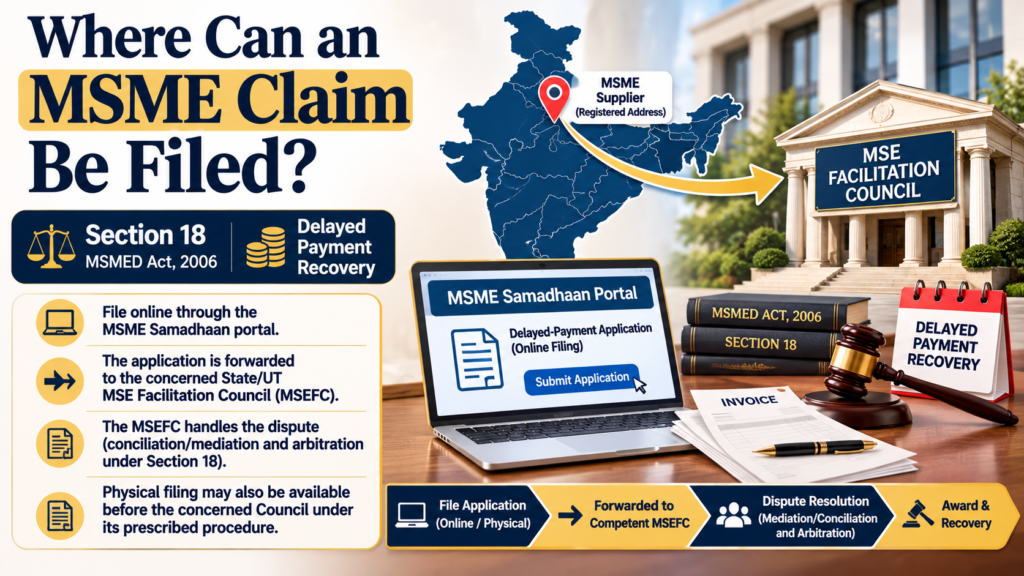
An eligible supplier can initiate a delayed-payment claim through the MSME Samadhaan portal or the applicable MSME online dispute resolution mechanism and pursue the matter before the competent Micro and Small Enterprises Facilitation Council. The Council has territorial jurisdiction based on the supplier’s official registered address under the applicable statutory framework.
The buyer may be located in another state. The supplier does not ordinarily need to file its MSME claim before the Council in the buyer’s state.
This article explains where an MSME payment recovery claim can be filed, how to determine the competent Council, the procedure under Section 18, the role of MSME Samadhaan and the legal remedies available to suppliers.
An eligible micro or small enterprise can file a delayed-payment reference before the competent Micro and Small Enterprises Facilitation Council under Section 18 of the MSMED Act, 2006.
The supplier can initiate the process through the following channels:
The MSME Samadhaan portal facilitates online filing and forwards the application to the concerned Facilitation Council. It does not independently adjudicate the payment dispute. The competent MSEFC conducts the statutory dispute resolution proceedings.
Official portal: https://samadhaan.msme.gov.in/
MSME ODR portal: https://odr.msme.gov.in/
The Micro and Small Enterprises Facilitation Council is a statutory dispute resolution authority established under Section 20 of the MSMED Act.
State Governments establish these Councils to address disputes involving delayed payments to eligible micro and small enterprises.
The Council provides a statutory mechanism through which suppliers can seek recovery of outstanding payments from buyers.
Its functions include:
Section 18 establishes the dispute resolution mechanism, while Sections 20 and 21 deal with the establishment and constitution of the Facilitation Council under the applicable statutory framework.
Territorial jurisdiction is one of the most important considerations when filing an MSME claim.
The supplier should approach the Council having jurisdiction over its relevant official registered address.
The MSMED Amendment Act, 2026 has clarified this position. The amended Section 18(5) provides that the MSME Facilitation Council, mediation service provider or relevant alternative dispute resolution institution or centre has jurisdiction in a dispute between:
The amendment came into force on 15 October 2026 in respect of the relevant provisions.
Accordingly, the supplier’s official registered address is an important factor in identifying the competent MSEFC.
| Supplier’s registered location | Buyer’s location | Competent Council |
|---|---|---|
| Delhi | Mumbai | Delhi MSEFC having jurisdiction |
| Uttar Pradesh | Haryana | Relevant Uttar Pradesh MSEFC |
| Maharashtra | Delhi | Relevant Maharashtra MSEFC |
| Karnataka | Tamil Nadu | Relevant Karnataka MSEFC |
| Gujarat | West Bengal | Relevant Gujarat MSEFC |
These examples illustrate the general statutory principle. The actual Council must be identified by checking its notified territorial limits and the supplier’s registered address.
Ordinarily, no. The special territorial jurisdiction rule under Section 18(5) links the statutory forum to the supplier’s official registered address.
For example, if a supplier is registered in Delhi and supplies goods to a buyer in Mumbai, the supplier can ordinarily approach the competent Delhi MSEFC rather than filing the statutory reference before the Maharashtra MSEFC merely because the buyer is located there.
The place of delivery may be relevant to other contractual and civil jurisdiction questions. However, it does not ordinarily replace the specific territorial jurisdiction rule under Section 18(5).
A contractual clause specifying the exclusive jurisdiction of courts in a particular city does not, by itself, displace the statutory jurisdiction of the competent MSEFC.
The statutory mechanism under the MSMED Act must be considered independently of ordinary contractual jurisdiction provisions.
Yes. The MSME Samadhaan portal provides an online facility for filing delayed-payment applications.
The Ministry of MSME launched the portal to facilitate recovery claims by eligible micro and small enterprises.
The portal enables suppliers to submit details of outstanding payments and supporting documents electronically.
Step 1: Visit the MSME Samadhaan portal
Visit: MSME ODR Portal
Step 2: Select the delayed-payment application facility
Access the appropriate application or login facility for submitting a delayed-payment reference.
Step 3: Enter Udyam registration details
Provide the required enterprise registration details and verify the supplier’s particulars.
Step 4: Enter buyer information
Provide the buyer’s legal name, address, contact details and other requested information.
Step 5: Upload invoice and transaction documents
Upload the relevant purchase orders, work orders, invoices, delivery documents and supporting correspondence.
Step 6: Enter outstanding amounts
Provide the principal amount due and the relevant invoice particulars. The statutory interest claim should be calculated under Section 16 of the MSMED Act.
Step 7: Submit the application
Review the details and submit the online application.
Step 8: Follow up with the competent MSEFC
The application is forwarded to the concerned Facilitation Council. The supplier should monitor the application and comply with further directions, including any requirements for physical documents or additional information under the applicable state rules.
It is important to understand that submitting an application on the Samadhaan portal does not itself constitute an arbitral award or an order directing the buyer to pay. The competent Council must undertake the statutory dispute resolution process.
Yes, subject to the applicable state rules and filing procedure.
The MSME Samadhaan portal is an online filing facility. It does not mean that every state requires the entire dispute resolution process to take place exclusively through that portal.
Some Councils prescribe additional requirements for submitting signed applications, affidavits, supporting documents and hard copies.
For example, a supplier filing before the Haryana MSEFC must examine the Haryana Micro and Small Enterprises Facilitation Council Rules, 2021 and the applicable filing requirements.
Therefore, the supplier should verify the relevant state notification and procedural rules before submitting the reference.
This question requires careful legal examination.
The MSMED Act creates a special statutory dispute resolution mechanism under Section 18. An eligible supplier can invoke this mechanism for recovery of amounts due under Section 17.
Where the statutory MSME remedy applies, the supplier should ordinarily consider filing before the competent MSEFC rather than immediately instituting an ordinary money recovery suit.
However, the availability of an ordinary civil or commercial remedy may depend on the supplier’s statutory eligibility, registration status, nature of the transaction, applicable amendments and the facts of the dispute.
A supplier should not assume that every invoice dispute automatically qualifies for an MSME reference.
Where the MSMED Act does not apply, the supplier may consider appropriate remedies under ordinary civil or commercial law, including a commercial recovery suit where the requirements of the Commercial Courts Act, 2015 are satisfied.
The legal strategy should be determined after examining the underlying contract, registration records, invoices and applicable judicial precedents.
The statutory delayed-payment mechanism under Sections 15 to 18 is available to eligible micro and small enterprise suppliers, subject to the applicable law.
The following considerations are important:
Micro and small enterprise classification: The supplier must fall within the applicable statutory classification.
Registration: The supplier’s registration under Section 8 and its official address must be examined in accordance with the amended law.
Nature of business: Manufacturing and service enterprises should verify their eligibility. Enterprises engaged solely in trading must separately examine applicable government directions restricting access to certain statutory benefits.
Relevant registration date: The date of registration in relation to the underlying supply or service is important. The Supreme Court has considered the effect of registration obtained after the transaction in Silpi Industries v. Kerala State Road Transport Corporation.
Nature of the transaction: The claim must arise from an eligible supply of goods or rendering of services.
An enterprise should therefore verify its legal eligibility before filing a reference.
An eligible supplier can seek recovery of the outstanding principal amount along with statutory interest.
Sections 15, 16 and 17 of the MSMED Act govern the buyer’s payment obligation and interest liability.
The supplier can claim the unpaid invoice amount or other legally recoverable dues arising from the supply of goods or services.
Section 16 provides for compound interest with monthly rests at three times the bank rate notified by the Reserve Bank of India.
Depending on the contract, statutory framework and facts, the supplier may also raise other legally sustainable monetary claims.
The supplier should prepare a detailed invoice-wise statement showing the principal outstanding, applicable payment deadline, interest commencement date and interest calculation.
Section 18 provides the statutory dispute resolution framework.
The proceedings generally involve the following stages.
The eligible supplier files a delayed-payment reference before the competent MSEFC.
The Council examines the reference and issues notice to the buyer, requiring the buyer to respond.
The statutory framework provides for an initial settlement process. Under the amended provisions, mediation is governed by the applicable provisions of the MSMED Act and the Mediation Act, 2023.
Where the mediation process fails, the dispute may proceed to arbitration before the Council or an appropriate institution or centre, as provided under Section 18.
The arbitral tribunal determines the dispute and issues an award in accordance with the applicable law.
The successful supplier may enforce the award through the applicable execution or recovery mechanism.
A supplier should prepare the following documents before filing a delayed-payment claim:
The documents should establish the commercial transaction, outstanding liability and the supplier’s eligibility under the MSMED Act.
The territorial jurisdiction provision under Section 18(5) expressly refers to a buyer located anywhere in India.
A foreign buyer presents a different jurisdictional issue.
The supplier should examine whether the transaction and buyer fall within the statutory framework, the applicable contract terms, the nature of the international commercial transaction and the enforceability of any resulting award.
A supplier should not assume that the phrase “anywhere in India” automatically extends the MSEFC’s jurisdiction to foreign buyers.
International commercial arbitration and contractual recovery remedies may also require consideration.
Citation: (2021) 18 SCC 790.
The Supreme Court examined the applicability of the MSMED Act where registration was obtained after the relevant contractual transactions.
The judgment is important when determining whether a supplier can claim statutory benefits for supplies made before obtaining the required MSME registration.
Citation: (2023) 6 SCC 401.
The Supreme Court considered the overriding effect of the MSMED Act and the relationship between the statutory dispute resolution mechanism under Section 18 and arbitration agreements.
The judgment reinforces the special statutory character of the MSME dispute resolution framework.
Citation: 2025 INSC 689.
The Supreme Court examined the territorial jurisdiction and contractual arbitration issues arising under Section 18 of the MSMED Act.
The judgment is relevant when a buyer and supplier are located in different states and the contract specifies a different arbitration seat.
These judgments should be read with the amendments to the MSMED Act, 2006, including the changes effective from 15 October 2026.
Suppliers should avoid the following mistakes:
A properly prepared claim with supporting documents and an accurate calculation can help avoid procedural objections and unnecessary delays.
An eligible micro or small enterprise can file a delayed-payment reference before the competent Micro and Small Enterprises Facilitation Council under Section 18 of the MSMED Act. The supplier can initiate the process through the MSME Samadhaan portal or the applicable online dispute resolution mechanism.
Yes. The MSME Samadhaan portal provides an online filing facility for delayed-payment applications. The application is forwarded to the competent MSEFC for further action.
Yes, where the supplier’s official registered address falls within the territorial jurisdiction of the competent Delhi MSEFC. The buyer’s location in Mumbai does not automatically require the supplier to file in Maharashtra.
The amended Section 18(5) links territorial jurisdiction to the supplier’s official address as recorded in its registration under Section 8. The supplier must identify the Council whose notified jurisdiction covers that address.
Yes. A supplier may approach the competent Council in accordance with the applicable state filing rules. Online filing through Samadhaan is also available.
No. The Samadhaan portal facilitates filing and monitoring. The competent MSEFC undertakes the statutory dispute resolution proceedings.
Yes. Under Sections 16 and 17, an eligible supplier can claim statutory compound interest with monthly rests at three times the RBI bank rate, subject to the applicable legal requirements.
Yes. A buyer may raise a legally sustainable jurisdictional objection. The Council and the competent adjudicatory forum will examine the objection under the applicable statutory provisions.
The delayed-payment provisions in Sections 15 to 18 are directed towards eligible micro and small enterprise suppliers. A medium enterprise should not assume that it qualifies for the same statutory remedy.
The requirement depends on the applicable state rules and Council procedures. Some Councils may require signed applications, affidavits or physical supporting documents even after online submission.
An MSME delayed-payment claim can be filed before the competent Micro and Small Enterprises Facilitation Council under Section 18 of the MSMED Act, 2006. The MSME Samadhaan portal provides an online mechanism for submitting the claim and forwarding it to the concerned Council.
The territorial jurisdiction of the Council is an important consideration. Under the amended Section 18(5), the supplier’s official registered address determines the relevant territorial jurisdiction, while the buyer may be located anywhere in India.
Before filing a claim, an MSME supplier should verify its registration, statutory eligibility, outstanding invoices, supporting documents and applicable interest calculation.
A properly prepared MSME reference can help suppliers pursue recovery of outstanding commercial dues through the special statutory dispute resolution mechanism.
NB Associates – Advocates & Legal Consultants
NB Associates advises micro and small enterprises on delayed-payment disputes, MSME Samadhaan applications, MSME Facilitation Council proceedings, arbitration and recovery of outstanding commercial payments.
Our legal services include:
Office: New Delhi and Ghaziabad, Delhi NCR
Phone: 9811899279
Email: mail@nbassociates.net
Contact NB Associates for legal assistance concerning MSME claim filing, MSME Samadhaan and recovery of delayed payments.
This page is intended for informative purposes only and does not constitute solicitation of client or legal advice.
For advice specific to your situation existing clients may please consult our team.
