MSME turnover Limit – What is MSME Latest turnover Limit
Law notes by NB Associates
Micro, Small and Medium Enterprises (MSMEs) are an integral part of any economy. They are the backbone of economic development in many countries, particularly in developing ones. MSMEs contribute significantly to the Gross Domestic Product (GDP), employment, and exports of a country.
The Government of India has taken several measures to promote and support MSMEs, including setting a turnover limit. This article will discuss the MSME turnover limit and its significance.
The MSME turnover limit is the maximum amount of revenue that an MSME can generate in a financial year. The turnover limit is defined based on the investment in plant and machinery or equipment for manufacturing or service enterprises.
In May 2020, the Government of India revised the MSME turnover limit to provide benefits to more enterprises. The new turnover limits for MSMEs are as follows:
Micro enterprises: Turnover up to INR 5 crore
Small enterprises: Turnover up to INR 50 crore
Medium enterprises: Turnover up to INR 250 crore
The above MSME turnover limit was notified vide notification dated 01.06.2020 being no F. No. 2/1(5)/2019-P&G/Policy (Pt.-IV). The same came into effect on 01.07.2020.
You may click here to access the notification.
You may click here to read MSME Act.
The revised MSME turnover limit has benefited many small businesses that were previously classified as large enterprises. These businesses can now avail of several benefits that were previously available only to MSMEs, such as credit guarantee schemes, government subsidies, and tax exemptions.
The MSME turnover limit is significant for several reasons, including:
1. Promoting Small Businesses:
The MSME turnover limit promotes small businesses and encourages entrepreneurship. The limit allows small businesses to avail of benefits and support from the government, which helps them to grow and expand their operations.
2. Employment Generation:
MSMEs are significant contributors to employment generation in the country. The turnover limit ensures that small businesses have access to benefits and support, which helps them to create more jobs and boost economic growth.
3. Access to Credit:
The MSME turnover limit allows small businesses to access credit facilities easily. Banks and financial institutions are more willing to lend to MSMEs as they are seen as less risky than large enterprises. The credit guarantee schemes offered by the government also make it easier for MSMEs to obtain loans.
4. Increase in Exports:
MSMEs are significant contributors to exports in many countries. The MSME turnover limit allows small businesses to avail of government subsidies and other benefits to boost their exports. This helps to increase the overall export revenue of the country
5. Promotion of Innovation:
MSMEs are often more innovative than large enterprises. The MSME turnover limit encourages small businesses to invest in research and development, which promotes innovation and creativity.
The MSME turnover limit is a significant policy measure that promotes small businesses and encourages entrepreneurship.
The revised MSME turnover limit has benefited many small businesses that were previously classified as large enterprises.
The turnover limit ensures that small businesses have access to benefits and support, which helps them to grow and expand their operations.
The MSME turnover limit also contributes significantly to employment generation, access to credit, increase in exports, and promotion of innovation.
Overall, the MSME turnover limit is a crucial policy measure for promoting the growth and development of small businesses in India.
___________________
What are the benefits of MSME registration?
What is the MSME Facilitation council?
How does MSME Facilitation Council work?
Where can an MSME claim be filed? Jurisdictions
Why is the filing of claim before the MSME Facilitation Council beneficial?
Whether Limitation Act applies to claims under MSME Act?
MSME Frequently Asked Questions – Read more
______________________________
Whether the condition of a 75% deposit under sec 19 MSME act is mandatory?
Can a deposit of 75% u/s 19 of the MSME Act be in Instalments?
Can the Bank guarantee be accepted as 75% pre-deposit u/s 19 MSME Act?
Law articles on MSME claim – Read more
Read : MSME case Study
MSME Limitation Act – Applicability on MSME recovery proceeding
Law Article by NB Associates
Whether there is any limitation on the MSME recovery proceedings which is initiated under the provisions of Sections 17 and 18 of the Micro, Small and Medium Enterprises Development Act, 2006?
Whether there is any MSME Limitation Act?
That is the moot point in this Law Article.
Another moot point would be if the law of limitation applies and the limitation has expired, What MSME can do? What is the way out for MSME? Does MSME have any way out?
There is no specific “MSME Limitation Act” in India. However, there are laws and regulations that apply to Micro, Small, and Medium Enterprises (MSMEs) in India.
We are among the top Law firms / Lawyers providing legal consultancy related to MSME dues recovery and handling related cases Pan India.
For any kind of legal consultancy, our client may contact us at the following number or email id :
Call us – 9811899279 | Email us – mail@nbassociates.net
Sections 17 and 18 of the Micro, Small and Medium Enterprises Development Act, 2006 provide for the recovery of the amount due for any goods or services rendered by the supplier.
This is applicable to the supplier which comes under the definition of Micro and Small Enterprises.
| Read more about MSME proceedings for recovery
Micro, Small and Medium Enterprises Development Act, 2006 does not specifically state whether the law of limitation is applied to the claims filed under this Act.
This Act is completely silent on this aspect.
Micro, Small and Medium Enterprises Development Act, 2006 (the ‘Act’) is a special Act.
This kind of specific act/law contains provisions of applicability of the Limitation Act, and other laws, however, this Act is silent on the applicability Limitation Act.
Before proceeding further let’s first see what is the limitation for filing the general money suit.
When it comes to general money suits, the law of limitation is very clear.
Law of Limitation provides that the money suit must be filed within a period of 3 (three) years from the date of cause of action i.e. from the date on which the right to sue arise.
This limitation is, however, subject to certain exceptions provided under Limitation Act.
In respect of the claim under the MSME Act, there has been confusion as to whether Limitation Act applies to claims under MSME Act.
MSME Office has clarified that its FAQ that the Limitation Act is not applicable as the arbitration proceeding arising out of this is statutory arbitration.
So, here comes the judgement of the Hon’ble Supreme Court in the Silpi Industries vs. Kerala State Road Transport Corporation & Anr case.
This case clarified the position as to whether the law of Limitation applies to the MSME recovery proceedings.
The Hon’ble Supreme Court has given a recent Judgment of M/s Silpi Industries vs. Kerala State Road Transport Corporation & Anr (CIVIL APPEAL NOS.1570-1578 OF 2021).
The Hon’ble Supreme Court held that the Limitation Act, 1963 is applicable in the Arbitration under the MSMED act, 2006.
Hon’ble Supreme Court noted :
Does this mean that you can still file a case with MSME Samadhan or the MSME Facilitation Council?
So, as per the judgment, the law of limitation applies to arbitration proceedings initiated under section 18(3) of the Act.
The judgement is however silent on the initial MSME proceeding e.g. filing of the claim with MSME Samadhaan and conciliation proceeding started under section 18(2). And the court has given its verdict on the arbitration proceeding under section 18(3).
Does this mean that you can still avail the facility of MSME Samadhan or MSME facilitation conciliation proceeding under section 18(2), that is the moot question.
Another moot question is whether availing MSME Samadhan facility or the conciliation proceeding will have no meaning in the absence of arbitration proceeding under section 18(3).
Now dealing with the question where limitation has expired, What MSME can do? What is the way out for MSME? Does MSME have any way out?
We think there is a way out in the form of section 22 of the MSMED Act and the mandatory provision of filing Form – 1 i.e. MSME return by the company under the Companies Act.
The above provisions come to the rescue of those who are struggling with the applicability of the law of limitation or for those whose limitation to initiate MSME recovery proceeding as expired.
Any form of entry of MSME debt in the audited financial statement or Form 1 – MSME return filed shall be treated as an acknowledgement of debt, and thus an extension of limitation under section 18 of the Limitation Act.
Section 22 of the Act mandates buyers to disclose the amount due to the suppliers in their audited financial statement.
Section 22 of the Micro, Small and Medium Enterprises Development (MSMED) Act mandates that all companies which have dues payable to micro and small enterprises must submit an annual statement of accounts specifying the amount of payment due and the reasons for the delay.
This statement must also include the amount of interest that has accrued on the unpaid amount, calculated in accordance with the provisions of the MSMED Act.
This requirement aims to ensure that micro and small enterprises are paid on time and that their dues are not held up indefinitely, which can lead to financial difficulties for these enterprises.
The natural consequence of the above is the admission or written acknowledgement of the debt by the buyer and thus help from section 18 of the Limitation Act, 1963.
Under the Companies Act, a company is required to file its financial statements and annual returns with the Registrar of Companies (RoC) within a specified time period. In addition to this, if the company has any outstanding payments due to micro and small enterprises, it is also required to file an MSME return in Form-1 under the MSMED Act
The MSME Form-1 requires the company to provide details such as the name of the enterprise, its type, PAN (Permanent Account Number), Aadhaar number, location, and bank account details. The form also requires the company to specify the amount of payment due and the reasons for the delay and to include the amount of interest that has accrued on the unpaid amount, calculated in accordance with the provisions of the MSMED Act.
How long can the seller/supplier delay the filing of such a claim before the MSEFC? This was a major loophole in the MSMED Act, 2006 which was resolved now by the Hon’ble Supreme Court of India.
Thus, the Limitation Act applies to MSMED Act, and a claim before MSEFC must be filed within 3 years from the date the right to sue arise.
In case of delay or expiry of 3 years, the MSME can have assistance from the MSME return in Form -1 filed by a company or from the provisions of section 22 of the Act.
_____________________________
Whether the condition of a 75% deposit under sec 19 MSME act is mandatory?
Can a deposit of 75% u/s 19 of the MSME Act be in Instalments?
Can the Bank guarantee be accepted as 75% pre-deposit u/s 19 MSME Act?
Law articles on MSME claim – Read more
______________________________
What are the benefits of MSME registration?
What is the MSME Facilitation council?
How does MSME Facilitation Council work?
Where can an MSME claim be filed? Jurisdictions
Why is filing of claim before the MSME Facilitation Council beneficial?
Whether Limitation Act applies to claims under MSME Act?
MSME Frequently Asked Questions – Read more
______________________________
Read : MSME case Study
How do I recover my MSME payment?
MSME Law notes by NB Associates
To recover your MSME payment, you can follow these steps
Send a formal reminder:
If a buyer has not made the payment within the agreed-upon period, send a formal reminder to the buyer.
The reminder should include the invoice number, date of delivery, and the amount due, and request the buyer to make the payment
Send a legal notice:
If the buyer does not respond to the reminder, send a legal notice to the buyer.
A legal notice is a formal communication that highlights the details of the outstanding payment and the consequences of non-payment.
File a complaint under MSME Samadhaan:
If sending reminders and legal notices do not yield any results, file a complaint on the MSME Samadhaan portal.
Provide all the necessary details, including invoices, delivery challans, purchase orders, and any other relevant documents.
Approach to MSME Facilitation Council
If the complaint filed on MSME Samadhaan is not resolved, you can approach under MSMED Act 2006 to concerned MSME Facilitation Council by physically filing the complaint.
Under this act, you can file a case in the Micro and Small Enterprises Facilitation Council (MSEFC).
The council will then try to settle the dispute through conciliation.
If conciliation fails, the MSME Facilitation Council shall refer matter to arbitration for adjudication of disputes.
Filing a commercial suit for recovery
If your invoice date is prior to your MSME registration, you may file a commercial suit for recovery.
A civil suit is a legal proceeding in which you can claim your outstanding payment along with interest and other damages..
It’s important to keep records of all communication related to the outstanding payment and maintain copies of all relevant documents for future reference
What is the interest rate for MSME claim?
MSME Law notes by NB Associates
As per the guidelines of the MSME Samadhaan portal in India, if a buyer fails to make payment to an MSME within 45 days of the acceptance or deemed acceptance of goods or services, the buyer will be required to pay interest to the MSME at a rate equal to three times the bank rate notified by the Reserve Bank of India.
The bank rate notified by the Reserve Bank of India currently stands at 6.5%, as of March 2023.
This means that the interest rate for MSME claims under the MSME Samadhaan portal is 3 times the current bank rate, which is 19.5% (6.5% x 3)
It’s worth noting that the interest rate can be subject to change as per the notification from the Reserve Bank of India, and MSME Samadhaan portal may update the interest rate accordingly.
Bank rate notified by RBI (Reserve Bank of India) since 2018.
| Date from | Date to | RBI Bank rate |
| 01/08/2018 | 06/02/2019 | 6.75% |
| 07/02/2019 | 03/04/2019 | 6.50% |
| 04/04/2019 | 05/06/2019 | 6.25% |
| 06/06/2019 | 06/08/2019 | 6% |
| 07/08/2019 | 03/10/2019 | 5.65% |
| 04/10/2019 | 26/03/2020 | 5.40% |
| 27/03/2020 | 21/05/2020 | 4.65% |
| 22/05/2020 | 03/05/2022 | 4.25% |
| 04/05/2022 | 07/06/2022 | 4.65% |
| 08/06/2022 | 04/08/2022 | 5.15% |
| 05/08/2022 | 29/09/2022 | 5.65% |
| 30/09/2022 | 06/12/2022 | 6.15% |
| 07/12/2022 | 28/02/2023 | 6.50% |
What are the benefits of MSME Samadhaan?
MSME Law notes by NB Associates
MSME Samadhaan is an online portal launched by the Indian government to facilitate the speedy settlement of disputes related to delayed payments for MSMEs.
The portal provides various benefits to MSMEs, including:
Resolution of MSME payment disputes
MSME Samadhaan provides an online platform for MSMEs to file their complaints regarding delayed payments.
This helps to speed up the dispute resolution process, allowing MSMEs to receive their payments more quickly.
Reduction in financial stress
MSMEs often face cash flow problems due to delayed payments from buyers, which can lead to financial stress.
MSME Samadhaan helps to alleviate this stress by providing a platform for the resolution of payment disputes.
Saving time and cost
The portal provides a cost-effective and time-saving solution for MSMEs to settle payment disputes without having to go through a lengthy and expensive legal process.
Promoting business growth
Timely payment settlements can help MSMEs to manage their working capital more efficiently, promoting their growth and expansion.
Encouraging buyer compliance
MSME Samadhaan encourages buyers to comply with the payment terms agreed upon with MSMEs, as non-compliance can result in penalties and damage to their credit rating.
Overall, MSME Samadhaan has been beneficial for MSMEs as it provides a speedy, cost-effective, and efficient solution for resolving payment disputes, promoting their financial stability and growth.
What is MSME 45 days payment rule
MSME Law Notes by NB Associates
In India, the MSME Act has introduced a 45-days payment rule for Micro & Small Enterprises.
So, if you are a Micro or Small enterprise, and you have sold goods or provided services to a Buyer, the Buyer must make payments for the goods or services within a maximum period of 45 (Forty-Five) days from the date of the delivery of the goods or services.
This MSME 45 days payment rule aims to improve the cash flow and liquidity of MSMEs, which often face challenges in managing their working capital due to delayed payments from buyers.
We are among the top Law firms / Lawyers providing legal consultancy related to MSME dues recovery and handling related cases Pan India.
For any kind of legal consultancy, our client may contact us at the following number or email id :
Call us – 9811899279 | Email us – mail@nbassociates.net
Provisions for the MSME 45 days payment rule lie in sections 15, 16 and 2(b) of the MSME Act.
The crux of the provisions is as under:
1. Where any supplier supplies goods or services to any buyer, the buyer must make payment on or before the date agreed between the buyer and supplier in writing.
Provided however that such an agreed period should not exceed 45 days.
2. 45 days counting to begin from the date of the delivery of the goods or services, as per section 2(b) of the MSME Act.
3. Where supplier and buyer have no agreement for the period within which payments are to be made, payments are to be made before the ‘appointed day’ i.e. within a period of 15 days from the date of the delivery of the goods or services. [Section 2(b) defines appointed day]
1. Where Supplier and Buyer have no agreement for the period during which payments are to be made:
The payments have to be made within a period of 15 days from the date of the delivery of the goods or services.
So, if Delivery was made on 01.01.2023, payment is to be made by 15.01.2023
2. Where Supplier and Buyer have an agreement for the period during which payments are to be made and such agreed period is more than 45 days.
The payments are to be made within a period of 45 days from the date of the delivery of the goods or services.
So, if Delivery was made on 01.01.2023, payment is to be made by 15.02.2023
3. Where Supplier and Buyer have an agreement for the period during which payments are to be made and such agreed period is more than 15 days and less than 45 days.
The payments are to be made within the agreed period from the date of the delivery of the goods or services.
So, if Delivery was made on 01.01.2023, and the agreed period of payment is 30 days then payment is to be made by 30.01.2023
As per provisions of section 16 of the MSME Act, If payment is not made during the given period, the Supplier is entitled to interest at the rate which is 3 times the bank rate notified by RBI.
This interest is compounding interest, which compounds at monthly intervals.
Section 16 reads as under:
16. Date from which and rate at which interest is payable.—Where any buyer fails to make
payment of the amount to the supplier, as required under section 15, the buyer shall, notwithstanding
anything contained in any agreement between the buyer and the supplier or in any law for the time being in force, be liable to pay compound interest with monthly rests to the supplier on that amount from the appointed day or, as the case may be, from the date immediately following the date agreed upon, at three times of the bank rate notified by the Reserve Bank.
The provisions of the MSME Act mandate that any buyer who purchases goods or services from an MSME must make the payment maximum within 45 (Forty-Five) days.
If the buyer fails to make the payment within 45 days, the buyer will be required to pay interest at a rate equal to three times the bank rate notified by the Reserve Bank of India.
The rule also helps to reduce the financial stress on MSMEs and promotes timely payments, which can help them to grow and expand their business.
_________________
Read more
___________________
__________________
_________________
MSME Case Filing – Step-by-Step Procedure
Law Article by NB Associates

Micro and small enterprises (MSEs) can file MSME case to recover their dues or outstanding by using the provisions of sections 15 to 18 of the MSME Act.
These provisions are an effective solution for the MSEs dues recovery.
Here we are going to discuss the step-by-step procedure for MSME case filing.
So how can one go for MSME case filing?
To know what legal services we provide in relation to MSME Recovery – Click here
We may be contacted at 9811899279 | mail@nbassociates.net
MSEs can file cases through MSME Samadhaan portal.
The Government of India launched the MSME Samadhaan portal in 2017. This portal allows MSMEs to file cases against buyers to recover their dues.
Access the MSME Samadhan Portal by following link:
https://samadhaan.msme.gov.in/MyMsme/MSEFC/COM_MSEFC_EntLogin.aspx
While filing an MSME case through the MSME Samadhaan portal, MSEs must upload relevant documents, including the contract or work order and invoices,
Once the MSE files the case online, they receive an acknowledgment of receipt and a unique case number to track the case’s progress.
The complainant or claimant should be a micro or small enterprise (MSE) as per the definition provided in the Micro, Small and Medium Enterprises Development (MSMED) Act, 2006.
The Ministry of Micro, Small, and Medium Enterprises (MSMEs) provides a valid Udyog Aadhaar Number (UAN), a 12-digit identification number, to MSEs, which the complainant or claimant must have.
Read More – Who is eligible for MSME Samadhan?
After filing an MSME case through the MSME Samadhaan portal, the system forwards the MSME complaint to the concerned buyer. The buyer has 15 days to respond to the complaint to the concerned complainant.
If an MSE files a case on the MSME Samadhaan portal and the buyer does not respond or pay, the system forwards the case to the respective MSME facilitation council.
MSME facilitation council then convert this complaint into an MSME case.
MSME facilitation council then start proceedings under section 18(2), which is a mandatory conciliation proceeding between the parties. If conciliation fails MSME facilitation council refers the matter to statutory arbitration.
MSME Samadhan portal has a dashboard that enables MSMEs to track the status of their complaints online. The portal also provides information related to the various schemes and policies of the Government related to MSMEs
Thus, a complainant can always track the MSME case filing status.
You can track your MSME case filing status by following links :
Tracking your case status here :
https://samadhaan.msme.gov.in/MyMsme/MSEFC/MSEFC_Entrepreneur_status.aspx
MSEs can issue a legal notice to the buyer demanding the payment of dues.
A legal notice serves as a warning to the buyer. It may prompt them to make the payment to avoid litigation.
However, it is not mandatory by law to issue a legal notice.
MSME facilitation council converts the complaint into an MSME case, when buyer does not pay or respond to the notice issued after complaint filing.
Once the case becomes an MSME case, Section 18(2) requires conciliation between the parties.
The council can itself conduct conciliation proceedings or it may seek the assistance of an institution by making a reference to such an institution or centre for conducting conciliation.
Sections 65 to 81 of the Arbitration & Conciliation Act, 1996 apply to such a dispute as if the parties had initiated conciliation under Part III of the Arbitration & Conciliation Act, 1996
If conciliation under section 18(2) is not successful or is terminated without a settlement, the MSME facilitation council refers the dispute to arbitration for adjudication as per the law.
The council can itself take the dispute for arbitration or refer the dispute to any institution or centre providing alternate dispute resolution services for such arbitration.
The provisions of the Arbitration & Conciliation Act, 1996 apply to such arbitration proceeding or disputes.
Section 19 of the MSME Act, provides for an application for setting aside a decree, award or order arising out of an arbitration proceeding can be filed.
The Arbitration and Conciliation Act, 1996 applies to any alternate dispute resolution or arbitration initiated under this Act.
Hence, a party can file an objection or application to set aside the decree or award order as per the provisions of Section 34 of the Arbitration and Conciliation Act, 1996, read with Section 19 of the MSME Act..
Parties can execute the decree, award, or order as per the provisions of Section 36 of the Arbitration and Conciliation Act, 1996..
Certain states have formulated their own rules allowing the recovery of the decree amount as arrears of land revenue, such as Rule 5 of the Madhya Pradesh Micro and Small Enterprises Facilitation Council Rules, 2006.
MSME case filing provisions as provided under the MSME Act, and Govt of India initiative in the form of MSME Samadhan portal is a significant step towards creating a more business-friendly environment and improving the ease of doing business in the country.
The provisions of filing case through MSME Samadhan reduces the need for physical visits to government offices, saves time and resources, and provides greater transparency and accountability in the MSME dispute resolution process.
MSME case filing process is a significant step. It has made the recovery process easy for MSME.
MSME case filing through the MSME Samadhan portal awareness is gaining moment. However, we need to raise more awarenes.
Both the State and Central Governments need to make improvements in certain areas.
Hopefully, the Government is ensuring that it takes more and more improvement initiatives.
MSME Online Case Filing – the process is a significant step
Law Article by NB Associates
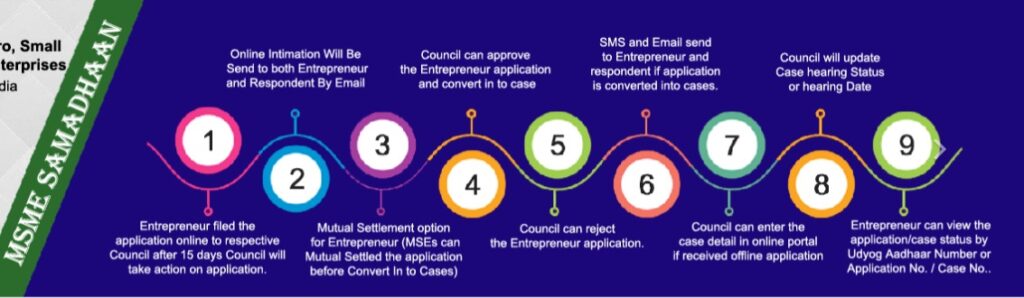
Micro and small enterprises (MSEs) can recover their dues or outstanding by using the provisions of sections 15 to 18 of the MSME Act. These provisions are an effective solution for the MSEs debt recovery.
For debt recovery, MSEs can start with MSME online case filing.
MSME online case filing refers to the process of filing a case related to MSMEs through online channel.
It provides a convenient and efficient way for MSEs to file their grievances and seek redressal of their MSME complaint.
MSEs can file online case through MSME Samadhaan portal.
The MSME Samadhaan portal was launched by the Government of India to facilitate the settlement of disputes related to payment of dues by MSEs.
MSEs can file a case in the portal and the concerned authority takes appropriate action to resolve the dispute
MSME Samadhaan portal provide a quick and easy platform for resolving grievances related to the delayed payment of dues by buyers to MSMEs. The portal is designed to empower the MSMEs and ensure the timely settlement of their disputes.
MSME Samadhan portal enables MSEs to file their complaints online against buyers who have failed to make payments for the goods or services provided by the MSEs.
The portal allows MSMEs to file complaints with necessary documents such as invoices, work orders, contracts, etc.
After MSME online case filing through MSME Samadhaan portal, the complaint is then forwarded to the concerned buyer. The buyer is given 15 days to respond to the complaint, and the concerned authorities take necessary actions to recover the amount due to the MSME.
MSME Samadhan portal has a dashboard that enables the MSMEs to track the status of their complaints online. The portal also provides information related to the various schemes and policies of the Government related to MSMEs
Overall, the MSME Samadhan portal is a useful initiative by the Government of India to provide MSMEs with an easy and hassle-free mechanism to resolve their grievances related to delayed payments by buyer.
MSMEs may also be required to upload relevant documents, such as contracts, work order and invoices.
Once the case is filed online, the MSME will receive an acknowledgement of receipt and a unique case number, which can be used to track the progress of the case.
If a buyer does not pay after a case has been filed by an MSME on the MSME Samadhan portal, the case is forwarded to the respective MSME facilitation council.
MSME facilitation council then start proceedings under section 18(2), which is a mandatory conciliation proceeding between the parties. If conciliation fails MSME facilitation council refers the matter to statutory arbitration.
MSEs can issue a legal notice to the debtor demanding the payment of outstanding dues.
A legal notice serves as a warning to the debtor and may prompt them to make the payment to avoid further legal action
However, it is not mandatory by law to issue a legal notice.
The supplier should be a micro or small enterprise (MSE) as per the definition provided in the Micro, Small and Medium Enterprises Development (MSMED) Act, 2006.
The supplier should also have a valid Udyog Aadhaar Number (UAN), which is a 12-digit identification number provided to MSEs by the Ministry of Micro, Small and Medium Enterprises (MSMEs)
Read More – Who are eligible for MSME Samadhan?
MSME Online case filing is a significant step towards creating a more business-friendly environment and improving the ease of doing business in the country.
It reduces the need for physical visits to government offices, saves time and resources, and provides greater transparency and accountability in the MSME dispute resolution process.
MSME Online Case Filing has helped MSMEs in several ways, some of which are :
Convenience: Online case filing has made it easy and convenient for MSEs to file their complaints and seek redressal for their grievances related to delayed payments or other issues. They can file their complaints from anywhere at any time, without the need to physically visit the concerned authorities.
Time-saving: Online case filing has reduced the time taken for filing complaints and seeking redressal. The process is streamlined, and MSEs receive an acknowledgement of receipt and a unique case number, which can be used to track the progress of the case.
Transparency: Online case filing has increased transparency and accountability in the dispute resolution process. MSEs can track the progress of their cases online and receive updates on the actions taken by the concerned authorities.
Efficiency: Online case filing has improved the efficiency of the dispute resolution process. The concerned authorities can quickly access the complaint and take appropriate actions to resolve the issue, leading to faster resolution of dispute.
Reduced costs: Online case filing has reduced the costs associated with filing complaints and seeking redressal. MSEs do not need to spend money on travel or legal fees, and the process is faster and more efficient, reducing the overall cost of dispute resolution.
Overall, MSME Online Case Filing has helped MSEs to resolve their disputes related to delayed payments or other issues in a timely and efficient manner, thus promoting a business-friendly environment and improving the ease of doing business in the country.
MSME online case filing process is a significant step. It has made the recovery process easy for MSME.
MSME online case filing awareness is gaining moment. However more and more awareness is to be done.
There is also some area where improvement is to be made by Government.
Law is always evolving and hopefully, Government is taking care that more and more improvement initiatives taken.
_____________________________
Whether the condition of a 75% deposit under sec 19 MSME act is mandatory?
Can a deposit of 75% u/s 19 of the MSME Act be in Instalments?
Can the Bank guarantee be accepted as 75% pre-deposit u/s 19 MSME Act?
Law articles on MSME claim – Read more
______________________________
MSME Frequently Asked Questions
What are the benefits of MSME registration?
What is the MSME Facilitation council?
How does MSME Facilitation Council work?
Where can an MSME claim be filed? Jurisdictions
Why is filing of claim before the MSME Facilitation Council beneficial?
Whether Limitation Act applies to claims under MSME Act?
MSME Frequently Asked Questions – Read more
______________________________
Read : MSME case Study
Who are eligible for MSME Samadhan?
Legal points by NB Associates
MSME Samadhaan is an online portal that provides a mechanism for micro and small enterprises (MSEs) to file their delayed payment complaints. The eligibility criteria for filing a complaint on the MSME Samadhaan portal are as follows:
1. The supplier should be a micro or small enterprise (MSE) as per the definition provided in the Micro, Small and Medium Enterprises Development (MSMED) Act, 2006.
2. The supplier should have a valid Udyog Aadhaar Number (UAN), which is a 12-digit identification number provided to MSEs by the Ministry of Micro, Small and Medium Enterprises (MSMEs)
3. The buyer should be a public sector enterprise or a company or a registered society or a trust or a limited liability partnership or any other entity engaged in the production or supply of goods or services.
4. The payment for the supplies made by the supplier should have been due for a period of more than 15 days from the date of acceptance of the goods or services or the date of deemed acceptance.
5. The supplier should have raised an invoice for the supplies made and the same should have been accepted by the buyer or deemed to have been accepted by the buyer.
MSEs meeting the above eligibility criteria can file their delayed payment complaints on the MSME Samadhaan portal.
The portal provides a platform for MSEs to file their complaints and track the status of their complaints.
How effective is MSME Samadhaan? Is MSME Samadhan effective ?
MSME Law points by NB Associates
MSME Samadhaan is an online portal that provides a mechanism for micro and small enterprises (MSEs) to file their delayed payment complaints.
The effectiveness of the portal in resolving delayed payment complaints depends on several factors, including the number of complaints filed, the response time of the concerned parties, and the efficacy of the dispute resolution mechanism.
Since its launch in 2017, MSME Samadhaan has received a significant number of delayed payment complaints from MSEs.
The portal has been successful in resolving a large number of complaints and ensuring that payments are made to the MSEs within the stipulated time period.
According to the Ministry of Micro, Small and Medium Enterprises, as of November 2020, MSME Samadhaan had resolved over 31,000 delayed payment complaints, resulting in the recovery of over Rs. 3,800 crores for MSEs.
One of the strengths of MSME Samadhaan is its ability to provide a time-bound and efficient mechanism for the resolution of delayed payment complaints.
The portal provides a platform for MSEs to file their complaints and track the status of their complaints.
The portal also facilitates communication between the parties and ensures that the concerned parties are notified of the complaint and given a reasonable opportunity to respond.
However, despite the effectiveness of MSME Samadhaan, delayed payment continues to be a significant problem for MSEs in India.
Many MSEs face challenges in accessing credit, managing cash flow, and meeting their operational expenses due to delayed payments from their buyers.
Therefore, there is a need for greater awareness about the provisions of the Micro, Small and Medium Enterprises Development (MSMED) Act, 2006 and the use of mechanisms like MSME Samadhaan to address delayed payment issues.
This page is intended for informative purposes only and does not constitute solicitation of client or legal advice.
For advice specific to your situation existing clients may please consult our team.
